

Discription
DAAYRA (2026)
Summary:
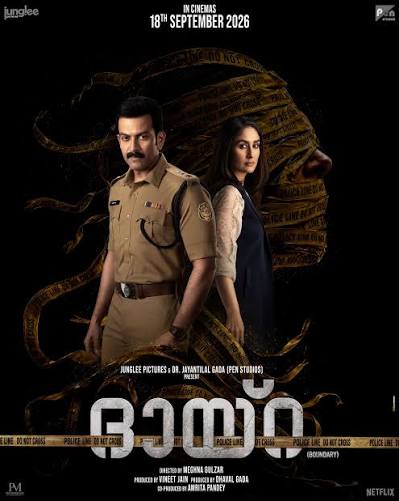
Daayra (translating to Circle or Boundary) is an upcoming 2026 Indian Hindi-language investigative crime thriller film co-written and directed by acclaimed filmmaker Meghna Gulzar (Talvar, Raazi, Sam Bahadur) and produced by Vineet Jain and Dhaval Gada under the banners of Junglee Pictures and Pen Studios. Starring Kareena Kapoor Khan as DCP Ajooni Kohli IPS and Prithviraj Sukumaran as DCP Raman Kumar IPS in commanding lead performances, the film features an exceptional ensemble cast including Kanwaljit Singh, Achint Kaur, Jitendra Joshi, Biswapati Sarkar, Anuja Sathe, and Kshitee Jog. Inspired by true events surrounding high-profile crimes and controversial extrajudicial encounter killings in India, the narrative places two upright, decorated police officers on opposing sides of the criminal justice system. When an encounter specialist eliminates four suspects accused of a heinous crime to widespread public applause, an uncompromising internal investigator is tasked with uncovering whether the shootout was a legitimate act of self-defense or a staged institutional cover-up. Featuring a haunting musical score by Ketan Sodha, the original song "Sach Ka Daayra" composed by Amit Trivedi with lyrics by Gulzar, and razor-sharp cinematography by Saurabh Goswami, Daayra is a searing, morally complex examination of jurisprudence, accountability, and the dangerous threshold between vengeance and justice. Keywords: Daayra Movie 2026, Kareena Kapoor Daayra, Prithviraj Sukumaran Daayra, Meghna Gulzar Director, Junglee Pictures Crime Thriller, Encounter Killing Hindi Movie.
Plot:
The atmospheric and bone-chilling narrative of Daayra opens in the chilly pre-dawn mist on the outskirts of an industrial highway corridor. The nation is currently engulfed in an unprecedented wave of collective rage, street protests, and grief following the monstrous abduction, sexual assault, and murder of a young veterinarian whose charred remains were discovered discarded beneath an overpass culvert. With the public, 24-hour news networks, and civil society demanding instantaneous retribution and questioning the competence of law enforcement, the state administration is under immense pressure to deliver immediate results. Heading the localized manhunt is Deputy Commissioner of Police Raman Kumar IPS, a battle-hardened, relentless officer who is widely known for his decisive, unyielding approach to criminal enforcement. Acting on swift surveillance and digital forensic tracing, Raman and his special team apprehend four suspects within days. While the arrests bring temporary relief, the volatile climate worsens as outraged mobs attempt to breach the local police lockup, baying for public lynchings and extrajudicial capital punishment.
The central turning point of the story occurs during an unannounced, middle-of-the-night crime scene recreation. Under the pretext of retrieving the victim’s concealed cell phone and the accelerants used in the crime, Raman’s tactical squad transports the four accused to the deserted wasteland where the body was originally discovered. Within hours, news flashes across the country: during an alleged escape attempt wherein the suspects purportedly snatched service revolvers and pelted the police with stones, Raman’s unit opened fire in self-defense, gunning down all four accused on the spot. The nation erupts into wild jubilation; flowers are showered on police vehicles, firecrackers are burst outside stations, and Raman is instantly elevated into a messianic folk hero who delivered swift, unburdened justice where the formal legal apparatus was expected to drag on for decades. Amid the national celebration, however, human rights commissions and judicial overseers raise serious red flags, suspecting that the operation was a calculated, staged summary execution designed to placate public hysteria.
To preserve the institutional credibility of the police force, the High Court and the Ministry of Home Affairs constitute an independent, high-level Special Investigation Team (SIT) to conduct a transparent magisterial and forensic inquiry into the encounter. Appointed to head this politically fraught probe is Deputy Commissioner of Police Ajooni Kohli IPS, an exceptionally sharp, detached, and procedural investigator who has spent her career upholding the absolute sanctity of constitutional due process. Ajooni understands the staggering hostility awaiting her; by investigating Raman, she is immediately branded by the media and the public as an unpatriotic bureaucrat defending brutal criminals against heroic cops. Refusing to yield to external noise, Ajooni establishes her headquarters in a secluded annex and begins a methodical, forensic dissection of the encounter site, operating on the premise that physical science never lies, regardless of public emotion.
The narrative transforms into an absorbing, high-tension clash of ideologies between two formidable officers who share mutual respect but stand on diametrically opposed philosophies of justice. Ajooni’s forensic sweep uncovers critical discrepancies that disrupt Raman’s official narrative. Reconstructed ballistics trajectories indicate that the bullets entered the suspects’ bodies at downward angles inconsistent with a chaotic, running scuffle, while gunshot residue tests on the suspects' hands reveal no traces of having fired the seized police weapons. Furthermore, surveillance footage retrieved from distant highway toll plazas contradicts the official logbook timings of the police caravan. When Ajooni interrogates the junior constables involved in the shootout, she observes behavioral tells of intense psychological trauma, guilt, and coached testimonies, orchestrated by Raman’s trusted sub-inspectors to ensure the team presents an airtight, unified front.
Parallel to the forensic probe, the film delves into Raman Kumar’s psychological landscape, subverting the cliché of the arrogant rogue cop. Raman is not a sadistic killer; he is a man who has witnessed firsthand the chronic failures, endless judicial adjournments, witness intimidations, and bureaucratic corruption that allow perpetrators of heinous crimes to exploit systemic loopholes and escape conviction. To Raman, the encounter was an act of moral surgery—a decisive blow to restore public faith and provide definitive closure to a broken, weeping family that the formal courts would have put through a prolonged, revictimizing trial. When Ajooni summons Raman for grueling formal depositions, their closed-door interrogations turn into blistering philosophical duels. Raman challenges Ajooni’s rigid idealism, arguing that the system’s sacred rules often protect the monster while leaving the victim undefended. In response, Ajooni delivers a chilling counterpoint: when the guardians of the law arbitrarily decide who lives and who dies, they do not destroy criminality; they simply replace the rule of law with state-sanctioned barbarism, creating a precedent where anyone can be eliminated under the guise of an encounter.
The tension reaches a boiling point when Ajooni’s team uncovers a devastating revelation that threatens to bring down the highest levels of the state government. Digital metadata and call detail records reveal that Raman did not act merely on personal instinct; he was receiving backchannel communications from political power brokers who orchestrated the execution to avert an impending election boycott. Worse, ballistic evidence reveals that one of the four slain men was a minor bystander whose vehicle had broken down near the scene, swept into the dragnet to construct a convenient, complete set of culprits. Armed with this incontrovertible proof of institutional murder, Ajooni faces fierce resistance. Internal departmental pressures mount to dilute the SIT report, her family is subjected to online doxxing and public intimidation, and senior bureaucrats offer her career advancements in exchange for classifying the shootout as an unfortunate operational accident.
The climax of the film takes place inside a packed judicial commission inquiry room, where the final, unvarnished findings of the investigation are formally tabled. In a tour-de-force courtroom and deposition sequence, Ajooni lays out the forensic reconstructions, the fabricated weapon seizures, and the audio recordings that dismantle Raman’s heroic facade, exposing the calculated mechanics of the encounter. Raman stands quietly in the docket, neither begging for forgiveness nor denying the forensic facts, bearing the burden of his choices with stoic dignity. The film delivers a devastating, emotionally resonant resolution as the commission indicts the officers for procedural homicide, stripping away the celebratory myths created by media sensationalism. The final moments of Daayra offer a somber, profound meditation on the essence of a civilized democracy, demonstrating that while the shortcut of instant vengeance may satisfy the fury of the present, true justice demands the patience to remain within the sacred, agonizing boundary of the law.
Cast:
-
Kareena Kapoor Khan as DCP Ajooni Kohli IPS (Head of the SIT Investigation)
-
Prithviraj Sukumaran as DCP Raman Kumar IPS (Encounter Specialist / Accused Officer)
-
Kanwaljit Singh as Justice S. N. Mathur (Head of Judicial Commission)
-
Achint Kaur as Senior Advocate Sunanda Deshpande
-
Jitendra Joshi as Inspector Madhav Suryavanshi (Raman's Deputy)
-
Biswapati Sarkar as Forensic Cyber Analyst Anirudh Sen
-
Anuja Sathe as Dr. Sneha Roy (Chief Ballistics & Forensic Pathologist)
-
Prammod Sanghi as Abhinandan Basu
-
Kshitee Jog as Kamla Devi
-
Trupti Khamkar as Sub-Inspector Rekha Patil
-
Seema Azmi as The Victim's Mother
-
Pragati Mishra
-
Mounis Ratta
-
Sumali Khaniwale
-
Upendra Chauhan as Bishal Mishra
-
Satish Badal
-
Ashiesh Bist
-
Ashutosh Sohan as Bablu Chaubey
Crew:
-
Director: Meghna Gulzar
-
Writers: Meghna Gulzar, Sima Agarwal, Yash Keswani (Story, Screenplay, & Dialogues)
-
Producers: Vineet Jain, Dhaval Gada
-
Co-Producer: Amrita Pandey
-
Production Companies: Junglee Pictures, Pen Studios
-
Theatrical Distribution: Pen Marudhar
-
Music Composer (Songs): Amit Trivedi
-
Lyrics: Gulzar
-
Original Background Score: Ketan Sodha
-
Cinematographer (DOP): Saurabh Goswami (ISC)
-
Editors: Charu Shree Roy, Meghna Gulzar
-
Sound Designer: Ayush Ahuja
-
Re-Recording Mixer: Debajit Changmai (Futureworks Media Ltd)
-
Casting Director: Taran Bajaj
-
DI Colourist: Ashirwad Hadkar (Redefine)
Release Info:
-
Theatrical Release Date: 18 September 2026 (Worldwide)
-
Original Language: Hindi
-
Genre: Crime Thriller / Legal Drama / Procedural Mystery
-
Running Time: 143 Minutes (2 Hours 23 Minutes)
-
Censor Certification: A (Adults Only)
-
Digital & Streaming Rights: Amazon Prime Video (Post-Theatrical)