

Discription
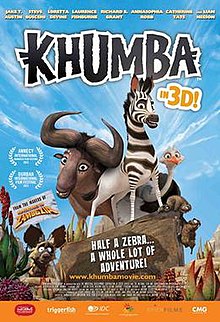
In the heart of the arid Great Karoo, a zebra foal named Khumba entered the world, marked by a striking anomaly: he was born half-striped, a stark contrast to the fully striped members of his herd. This deviation from the norm cast a shadow over his early life, setting him apart in a community where uniformity was prized.
Khumba's parents, Lungisa, his gentle mother, and Seko, the herd's stern leader, did their best to shield him from the whispers and sidelong glances. Yet, the drought that plagued the land became a cruel catalyst for prejudice. Superstition took root, and Khumba, with his unusual markings, was scapegoated, unfairly blamed for the parched earth and dwindling water. He became an outcast, a symbol of misfortune, ostracized by all except for Tombi, a spirited female zebra and his dearest friend. Tombi, too, felt the sting of societal disapproval, her tomboyish nature clashing with the herd's expectations of feminine grace.
One day, a whimsical mantis, with his artistic flair, drew a map in the dust, a striated representation hinting at a hidden water source. This sparked a flicker of hope in Khumba's heart. Driven by desperation, he made a fateful decision, allowing a group of thirsty gemsboks to share the herd's precious watering hole. This act of compassion, however, was met with harsh punishment, further solidifying his status as a pariah.
The looming threat of a murderous leopard named Phango added to the herd's woes. Phango, a creature of primal terror, warned Mkhulu, the wise elder, that the herd faced certain death unless they migrated in search of water. Lungisa, sensing the impending danger, shared an ancient legend, a tale of how the first zebras were once plain white. A young, adventurous zebra, seeking respite from the harsh sun, stumbled upon a mystical watering hole hidden within a cave. Upon immersing himself in the water, he emerged with vibrant stripes, a transformation that was then shared by the entire herd.
The loss of Lungisa, Khumba’s mother, served as a painful turning point, propelling him into a perilous journey. He ventured into the vast, unforgiving landscape, where he encountered Skalk, a cunning African wild dog. Skalk’s predatory nature was thwarted by the intervention of Mama V, a compassionate wildebeest, and Bradley, a quirky ostrich. This unlikely trio, bound by their shared vulnerability, embarked on a quest for water, their path fraught with challenges. Bradley, with his candid honesty, revealed his near-death experience in a slaughterhouse, a testament to the harsh realities of survival.
Khumba's compassion continued to shine as he aided a migrating herd of springboks, helping them breach a formidable fence that barred their path. This act of kindness underscored his belief in unity and cooperation, values that stood in stark contrast to the herd's rigid adherence to tradition.
Their journey led them to a vibrant, eclectic community of animals residing within Ying's National Park. This bohemian enclave, a haven for diverse creatures, offered a glimpse of a world where differences were celebrated. However, their respite was short-lived, as park rangers, armed with tranquilizer darts, posed a new threat, capturing Bradley and imprisoning Khumba.
Undeterred, Khumba and his allies ascended a towering mountain, seeking the wisdom of the Black Eagle. Their ascent was hindered by a group of devout rock hyraxes, who zealously guarded the eagle's sanctuary. From the albino Black Eagle, Khumba learned the path to the magical watering hole, a place hidden within Phango's lair. The eagle also revealed Phango's tragic past, a tale of rejection and vengeance. Born with a blind eye, Phango was deemed unfit by his clan, a rejection that fueled his murderous rage. The eagle also revealed that Phango was hunting Khumba due to an old leopard myth that said the leopard who ate the half striped zebra would be the most powerful hunter.
Meanwhile, Seko, consumed by remorse, realized the gravity of his leadership. With Tombi's unwavering support, he understood that the herd's survival depended on their willingness to embrace change and seek a new home. He bravely led his herd, following Phango's trail, hoping to find Khumba and a new watering hole.
Khumba, navigating the labyrinthine depths of Phango's cave, discovered the hidden watering hole. As he gazed upon the shimmering water, he reflected on Lungisa's teachings and the diverse tapestry of experiences he had encountered. He realized that diversity was not a weakness but a strength, a vital ingredient for survival.
Phango, driven by his insatiable hunger for power, cornered Khumba, their confrontation escalating into a fierce battle. As the cave began to crumble, the assembled animals, having followed Seko, witnessed the epic clash. Khumba, using his agility and wit, evaded Phango's attacks, leading the leopard into a precarious position. The collapsing cave caused both of them to fall. Phango was killed by falling rocks, while Khumba fell into the water, and was washed ashore.
As rain began to fall, the animals mourned Khumba's apparent demise. But then, to their astonishment, he awoke, his spirit unbroken.
With Phango vanquished and the zebra herd finding a new home, a celebration ensued. Khumba, surrounded by his herd, Mama V, Bradley, Skalk, and the diverse community of animals he had befriended, embraced a future where unity and acceptance prevailed. The waterfall became a symbol of their shared resilience, a place where different species coexisted in harmony, their differences woven into a vibrant tapestry of life.