

Discription
SALAAM VENKY (2022)
Summary:
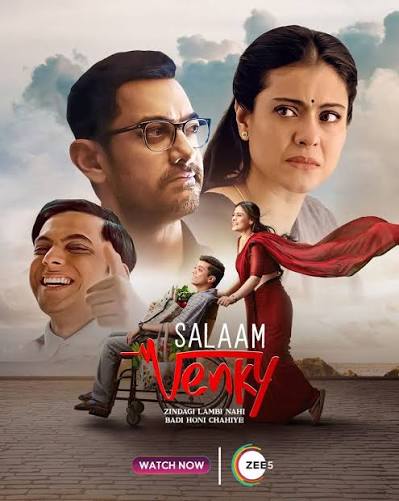
Salaam Venky (translating to Salute to You, Venky) is a 2022 Indian Hindi-language biographical slice-of-life drama directed by acclaimed actress-filmmaker Revathi (Mitr, My Friend, Phir Milenge) and written by Sammeer Arora, with dialogues by Kausar Munir. Adapted from the non-fiction book The Last Hurrah (2005) by Shrikant Murthy, the film is produced by Suraj Singh, Shraddha Agrawal, and Varsha Kukreja under the banners of Connekkt Media, Blive Productions, and RTake Studios, with theatrical distribution by Zee Studios / Zee Cinema. Starring Kajol and Vishal Jethwa in deeply moving lead performances, alongside an ensemble cast featuring Rajeev Khandelwal, Rahul Bose, Prakash Raj, Priyamani, Aahana Kumra, Riddhi Kumar, Aneet Padda, Kamal Sadanah, Anant Mahadevan, and a special cameo appearance by Aamir Khan, the film chronicles the inspiring real-life story of Kolavennu Venkatesh and his indefatigable mother, K. Sujata. Suffering from Duchenne muscular dystrophy (DMD)—a fatal genetic degenerative disorder—Venky defies medical prognoses to live to the age of twenty-four with infectious humor, philosophical grace, and an extraordinary final wish: petitioning the Indian judicial system for the right to active euthanasia so that his healthy organs may be harvested and donated to save other lives before his disease renders them unusable. Featuring cinematography by Ravi Varman and a soulful soundtrack composed by Mithoon, Salaam Venky celebrates unconditional maternal resilience and the principle that life must be measured by depth rather than length. Keywords: Salaam Venky 2022, Kajol Vishal Jethwa, Revathi Director, Kolavennu Venkatesh True Story, The Last Hurrah Shrikant Murthy, Duchenne Muscular Dystrophy Film, Mithoon Soundtrack, Aamir Khan Cameo.
Plot:
The story of Salaam Venky opens inside the intensive care unit of a multi-specialty hospital, introducing twenty-four-year-old Kolavennu Venkatesh Prasad Krishnan, affectionately called Venky. Completely paralyzed from the neck down and tethered to an array of vital life-support monitors and respiratory ventilators, Venky is in the advanced, terminal stage of Duchenne muscular dystrophy (DMD), a rare, progressive neuromuscular disease that systematically degenerates muscle tissue across the human body. Despite his acute physical confinement and excruciating discomfort, Venky’s mind remains razor-sharp, fiercely witty, and brimming with irrepressible humor. Tending to his every need at his bedside is his mother, Kolavennu Sujata Krishnan, a woman of boundless warmth, fierce optimism, and quiet emotional steel who refuses to allow grief or self-pity to darken her son's room. Treating Venky’s ward not as a sterile terminal bay, but as a lively arena of chess matches, Bollywood cinema trivia, and affectionate banter, Sujata transforms each passing hour into a celebration of life.
Through interlocking flashbacks, the narrative traces the long, arduous journey that brought mother and son to this pivotal juncture. Diagnosed with DMD during early childhood, Venky was given a bleak medical prognosis: doctors informed Sujata and her husband Karunesh Prasad that boys afflicted with this genetic condition rarely survive beyond the age of sixteen. While the devastating diagnosis fractured the marriage—leading an overwhelmed Karunesh to emotionally withdraw and eventually abandon the family—Sujata refused to surrender to despair. Moving forward alongside her young daughter Sharda, Sujata dedicated her entire existence to ensuring that Venky experienced a rich, dignified, and joyous upbringing. Supported by compassionate medical mentor Dr. Shekhar Tripathi, Sujata carried Venky on her back to classrooms, organized festive celebrations, and nurtured his passion for music, chess, and literature. Defying every statistical expectation, Venky not only crossed his sixteenth year, but graduated, mastered complex chess strategies, and grew into an empathetic young man beloved by neighbors, nurses, and friends, including his childhood companion Nandini, whom he quietly loved from afar.
However, as Venky enters his mid-twenties, the relentless progression of the disease finally reaches its final frontier, steadily compromising his cardiac and pulmonary functions. Recognizing with lucid clarity that his body is failing and that his natural death from respiratory arrest will cause progressive oxygen deprivation that destroys the viability of his vital internal organs, Venky makes an extraordinary, deeply selfless decision. Eager to ensure that his short existence leaves behind a tangible legacy of life for others, Venky resolves to donate his healthy eyes, heart, lungs, liver, and kidneys. Yet, under strict Indian medical and statutory laws, vital organ harvesting from a living patient requires brain-stem death, and active euthanasia (mercy killing) is strictly prohibited as a criminal offense, meaning that if Venky waits for natural organ failure, his organs will become medically unsuitable for transplantation.
Determined to fulfill her son's final wish regardless of the personal emotional agony it inflicts upon her maternal heart, Sujata takes up Venky’s battle against the state and judicial bureaucracy. Assisted by idealistic, principled human rights lawyer Parvez Alam and brought into the national spotlight by sympathetic television journalist Sanjana Aggarwal, Sujata files an unprecedented public interest writ petition before the High Court, seeking legal permission to withdraw Venky’s life-support systems under controlled medical supervision to facilitate immediate organ donation. The case ignites a passionate nationwide ethical, religious, and legal firestorm, pitting the constitutional right to die with dignity against the state's duty to preserve human life and prevent the misuse of euthanasia laws.
Inside the courtroom, Public Prosecutor Nanda Kumar vehemently opposes the petition, arguing that granting legal sanction to deliberate termination of life opens dangerous moral floodgates and contravenes established Indian penal statutes. Lawyer Parvez Alam counters with emotional and philosophical eloquence, presenting Venky’s plea not as an act of suicidal despair, but as the highest manifestation of altruism—a young man choosing to turn his inevitable death into an instrument of survival for half a dozen critically ill patients awaiting transplants. Presiding over the sensitive hearings is the compassionate, deeply introspective Justice Anupam Bhatnagar, who personally visits Venky in his hospital room to verify that the young man is acting of his own free will, free from any familial coercion. During their intimate conversation, Venky disarms the seasoned judge with his infectious smile, quoting classic cinema dialogues and articulating his philosophy that life should be badi (grand and meaningful), rather than lambi (merely long).
Throughout this grueling legal and emotional marathon, Sujata carries an unbearable private grief behind her radiant smile, drawing spiritual strength from quiet, surreal conversations with an imagined philosophical projection of her own conscience—personified by an enigmatic guide who reminds her of her sacred duty to let her child fly free when the time comes. In the poignant final stretch of the narrative, even as the judicial ruling faces procedural delays and ethical complexities, Venky’s physical condition rapidly deteriorates. Gathering around his bedside, Sujata, Sharda, Dr. Shekhar, Parvez Alam, Nandini, and even a remorseful Karunesh stand united in love and reverence. Surrounded by the people who cherished his luminous spirit, Venky passes away peacefully with a serene smile on his lips. Although legal barriers prevent the immediate harvesting of his solid internal organs, his healthy eyes are successfully donated, restoring sight to two visually impaired recipients. The film concludes on a deeply moving, triumphant tribute to Kolavennu Venkatesh, demonstrating how one young man’s indomitable courage forever shifted public discourse on organ donation and human dignity across India.
Cast:
-
Kajol as Kolavennu Sujata Krishnan (Venky's devoted, resilient mother)
-
Vishal Jethwa as Kolavennu Venkatesh "Venky" Prasad Krishnan (A 24-year-old suffering from Duchenne muscular dystrophy)
-
Rajeev Khandelwal as Dr. Shekhar Tripathi (Venky's compassionate longtime physician and family friend)
-
Rahul Bose as Advocate Parvez Alam (The empathetic lawyer fighting Venky's legal battle)
-
Prakash Raj as Justice Anupam Bhatnagar (The presiding High Court Judge)
-
Priyamani as Advocate Nanda Kumar (The Public Prosecutor representing the state)
-
Aahana Kumra as Sanjana Aggarwal (The dedicated television journalist covering Venky's story)
-
Riddhi Kumar as Sharda Prasad Krishnan (Venky's loving younger sister)
-
Aneet Padda as Nandini (Venky's childhood friend and unrequited love)
-
Kamal Sadanah as Karunesh Prasad (Venky's estranged father - Special Appearance)
-
Anant Mahadevan as Guruji
-
Maala Parvathi as Nurse Clara (Venky's primary ICU caretaker)
-
Aarman Sawant as Young Venkatesh (10 Years Old)
-
Raunak Sharma as Young Venkatesh (4 Years Old)
-
Richi Sharma as Young Sharda
-
Geeta Sodhi as Bhavani
-
Jaineeraj Rajpurohit as Mohan
-
Dilip Dhupia as Editor Partha Roy
-
Ajit Bhure as Ravindra Kaushik
-
Saurabh Sharma as Mr. Bharadwaj
-
Thirunavukkarasu as Ranganayak
-
Aamir Khan as Sujata's Conscience / Illusion (Special Cameo Appearance)
-
Revathi as Radha Bhatnagar (Justice Anupam Bhatnagar's wife - Uncredited Appearance)
Crew:
-
Directed by: Revathi
-
Screenplay: Sammeer Arora
-
Dialogues: Kausar Munir
-
Story & Source Material: Based on the book The Last Hurrah by Shrikant Murthy
-
Producers: Suraj Singh, Shraddha Agrawal, Varsha Kukreja
-
Production Companies: Connekkt Media, Blive Productions, RTake Studios
-
Theatrical & Satellite Distributor: Zee Studios / Zee Cinema
-
Director of Photography (Cinematographer): Ravi Varman
-
Film Editor: Manan Ajay Sagar
-
Music Composer (Songs & Original Score): Mithoon
-
Lyricists: Mithoon, Sandeep Shrivastava, Kausar Munir
-
Production Designer: Subrata Chakraborty, Amit Ray
-
Sound Designer: Bishwadeep Dipak Chatterjee
-
Costume Designer: Niharika Bhasin
-
Casting Director: Mukesh Chhabra
-
Music Label: Zee Music Company
Soundtrack:
The original soundtrack and score were composed and arranged by Mithoon, with lyrics penned by Mithoon, Sandeep Shrivastava, and Kausar Munir:
-
"Jo Tum Saath Ho" — Lyrics: Mithoon | Singer: Arijit Singh (5:49)
-
"Dhan Te Nan Zindagi" — Lyrics: Mithoon | Singers: Mohit Chauhan, Mithoon (4:18)
-
"Yu Tere Hue Hum" — Lyrics: Mithoon | Singers: Jubin Nautiyal, Palak Muchhal (3:59)
-
"Anda Bata Paratha" — Lyrics: Sandeep Shrivastava | Singers: Benny Dayal, Mithoon, Aditi Singh Sharma (3:18)
-
"Jo Tum Saath Ho (Duet)" — Lyrics: Mithoon | Singers: Arijit Singh, Shreya Ghoshal (5:49)
-
"Badi Zindagi" — Lyrics: Kausar Munir | Singer: Shaan (3:13)
-
"Jo Tum Saath Ho (Lullaby)" — Lyrics: Mithoon | Singers: Shreya Ghoshal, Shambhavi Thakur, Sminit Mhatre (1:56)
Total Album Runtime: 29 Minutes 22 Seconds
Release Info:
-
Theatrical Release Date: 9 December 2022
-
Country: India
-
Original Language: Hindi
-
Genre: Biographical Drama / Slice-of-Life / Legal Drama
-
Running Time: 136 Minutes (2 Hours 16 Minutes)
-
Censor Certification: U (Universal Exhibition - CBFC India)
-
Theatrical Box Office Gross: ₹1.99 Crore (Limited Arthouse Release)
-
Digital / OTT Streaming Premiere: 10 February 2023 on ZEE5
-
Satellite Television Rights: Zee Cinema