


Discription
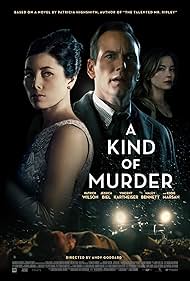
A KIND OF MURDER (1970)
Summary:
A Kind of Murder is a psychological thriller based on Patricia Highsmith's novel "The Blunderer," exploring the dark descent of a man into a web of suspicion and guilt. The film centers on Walter Stackhouse, a successful but deeply unhappy lawyer, who finds himself increasingly obsessed with the idea of murdering his wife, Clara. His morbid fascination leads him to investigate a seemingly perfect murder committed by a local bookseller, Melchior Kimmel, whose wife died under mysterious circumstances.
As Walter's fantasies bleed into reality, he begins to inadvertently implicate himself in Clara's eventual death, which occurs under ambiguous circumstances. The narrative skillfully blurs the lines between imagination and action, accident and intent, as a persistent police detective, Corby, pieces together Walter's erratic behavior and the unsettling parallels between his life and Kimmel's. The film delves into the psychological toll of guilt, paranoia, and the dangerous consequences of indulging dark impulses, creating a tense atmosphere where no one is entirely innocent and truth remains elusive.
Keywords: A Kind of Murder, 1970, Ian McShane, Susannah York, Anthony Franciosa, José Ferrer, Thriller, Crime, Drama, Patricia Highsmith.
Plot:
Walter Stackhouse, a seemingly successful New York lawyer, leads a life of quiet desperation. He is trapped in a loveless marriage with Clara, a beautiful but emotionally unstable woman whose erratic behavior and frequent accusations have driven a wedge between them. Walter fantasizes about escaping his marriage, and these fantasies gradually morph into a morbid obsession with the idea of murdering Clara. He meticulously plans hypothetical scenarios, even going so far as to visit isolated locations where he might dispose of a body, studying the logistics with a chilling detachment.
His dark fascinations intensify when he reads a newspaper article about Melchior Kimmel, a local bookseller whose wife recently died after falling down a flight of stairs. The police ruled it an accident, but Walter senses something more sinister, perceiving Kimmel as a kindred spirit who might have successfully executed the very crime Walter only dreams of. Driven by a perverse curiosity, Walter begins to stalk Kimmel, observing his routines and trying to understand the psychology behind such an act. He even engineers a meeting with Kimmel, subtly probing him about his wife's death, much to Kimmel's discomfort and growing suspicion.
Walter's behavior becomes increasingly erratic and self-destructive. He purchases a bus ticket for Clara to travel to her ailing mother's house, a trip he intends to be a one-way journey into oblivion. He then follows her bus in his car, intending to intercept her at a secluded rest stop and commit the act he has so long contemplated. However, at the last moment, he loses his nerve and drives past, leaving Clara to continue her journey. Tragically, Clara does not reach her destination; her body is found later, having fallen from a cliff near the rest stop. The circumstances are ambiguous: suicide, accident, or murder?
The death of Clara immediately draws the attention of Detective Corby, a shrewd and persistent investigator who quickly identifies Walter as the primary suspect. Corby is particularly intrigued by Walter's strange alibi and his prior, well-documented obsession with Kimmel's case. Walter, reeling from the shock and the sudden reality of his wife's death, finds himself entangled in a nightmarish web of circumstantial evidence. His earlier morbid curiosity, his visits to potential disposal sites, and his peculiar interactions with Kimmel now paint a picture of a man capable of murder, even if he didn't directly commit the act.
Kimmel, meanwhile, becomes increasingly paranoid. He is aware of Walter's strange fixation on him and fears that Walter is trying to implicate him in Clara's death or, worse, expose him for his own wife's murder, which Kimmel did indeed commit. Kimmel's guilt and fear drive him to desperate measures. He begins to stalk Walter in return, attempting to intimidate him and ensure his silence. This creates a dangerous cat-and-mouse game between the two men, each believing the other holds the key to their respective downfalls.
Detective Corby, observing the bizarre interactions between Walter and Kimmel, becomes convinced that there's a deeper connection between the two deaths. He meticulously reconstructs Walter's movements, interviews witnesses, and gathers evidence that, while not directly proving Walter's guilt in Clara's death, certainly paints him as a man with a motive and a peculiar predilection for murder. Corby’s investigations reveal a chilling pattern: Walter’s initial fantasies and preparations for Clara’s murder mirror the circumstances of her actual death, making it almost impossible for him to prove his innocence.
The tension escalates as Walter, desperate to clear his name and escape Corby's tightening net, becomes convinced that the only way out is to expose Kimmel. He believes that if he can prove Kimmel murdered his own wife, it might somehow exonerate him or at least divert suspicion. However, his attempts to gather evidence against Kimmel are clumsy and only serve to make him look more suspicious in Corby's eyes. Kimmel, feeling cornered, escalates his threats, leading to a direct confrontation between the two men. This confrontation forces Walter to face the full consequences of his initial dark thoughts and actions, realizing how his fantasies have irrevocably altered his reality.
In a climactic sequence, the truth begins to unravel. Walter manages to trick Kimmel into confessing details about his wife's murder, inadvertently creating a situation where Kimmel's guilt becomes undeniable. However, Walter's own actions remain ambiguous. It is revealed that Clara’s death was an accident, a fall from the cliff, but Walter’s preceding actions and his earlier intent made him look undeniably guilty. The film concludes with the implication that while Kimmel is brought to justice for his crime, Walter is left to grapple with the psychological scars of his own complicity, not in the physical act of murder, but in the corrosive power of his dark desires and the self-fulfilling prophecy of his morbid fascination. He is cleared of Clara's murder but forever haunted by the shadow of what he almost did, and the man he became in the process.
Cast (Lead Roles):
- Ian McShane as Walter Stackhouse
- Susannah York as Clara Stackhouse
- Anthony Franciosa as Melchior Kimmel
- José Ferrer as Detective Corby
- Delia Boccardo as Elena
Crew:
- Director: Brian G. Hutton
- Screenplay: Lorenzo Semple Jr.
- Based on the novel "The Blunderer" by: Patricia Highsmith
- Producer: Stanley Rubin
- Music by: John Scott
- Cinematography: Gerry Fisher
- Film Editing: Ralph Sheldon
Release Info:
- Original Release Date: August 1970 (USA)
- Language: English
- Genre: Thriller, Crime, Drama
- Running Time: 98 minutes
- Accolades: No major awards or nominations.