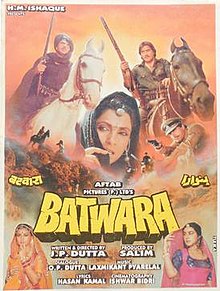


Discription
BATWARA (1989)
Summary:
Batwara, meaning 'partition' or 'division', is a powerful and emotionally charged Hindi drama that delves into the devastating consequences of greed and betrayal within a once-united family. Set against the backdrop of a sprawling ancestral estate in rural India, the film chronicles the bitter feud between two half-brothers, Shankar and Vijay, over their inheritance following the death of their revered patriarch. What begins as a dispute over land quickly escalates into a brutal struggle for dominance, fueled by a manipulative relative who exploits their vulnerabilities and deep-seated insecurities. The film masterfully portrays the erosion of familial bonds, the loss of innocence, and the relentless pursuit of justice amidst a landscape scarred by conflict.
As the brothers are pitted against each other, their respective wives, Suman and Priya, find themselves caught in the crossfire, struggling to protect their families and uphold their values. The narrative explores themes of loyalty, sacrifice, and the enduring strength of the human spirit in the face of adversity, culminating in a dramatic confrontation that forces all characters to confront the true cost of their divisions. Batwara serves as a poignant reminder of how easily material wealth can corrupt relationships and the profound importance of unity and forgiveness.
Keywords: Batwara, 1989, Dharmendra, Vinod Khanna, Dimple Kapadia, Amrita Singh, Amrish Puri, Drama, Action, Family, Land Dispute, Rural India, Betrayal, Inheritance.
Plot:
The story of Batwara unfolds in the picturesque village of Rampur, dominated by the vast agricultural lands and ancestral home of the formidable Thakur Raghuvir Singh. A man of immense wisdom and integrity, Thakur Raghuvir Singh is revered by the villagers and his family alike. He lives with his two sons, Shankar and Vijay, who are half-brothers but raised with equal love and care. Shankar, the elder, is a man of quiet dignity, deeply rooted in tradition and farming, content with his life alongside his devoted wife, Suman, and their young son. Vijay, younger and more ambitious, possesses a fiery spirit and a desire to modernize their farming practices. Despite their differing temperaments, the brothers share a strong bond, overseeing their fertile lands together, a testament to their father's legacy.
The idyllic harmony is shattered with the sudden illness and eventual passing of Thakur Raghuvir Singh. His death leaves a void not just in the family but in the entire village. The first cracks in the family's unity appear during the reading of his will. The will, seemingly straightforward, divides the estate equally between Shankar and Vijay. However, the Thakur's cunning cousin, Ranjit Singh, a man known for his avarice and manipulative nature, begins to sow seeds of discord. Ranjit subtly misinterprets clauses regarding the most fertile plots and water rights, suggesting that certain valuable portions should fall under Vijay's direct control, implying Shankar's traditional methods are less efficient. Vijay, influenced by Ranjit's persuasive arguments about progress and maximizing profits, begins to view his elder brother's methods as archaic and a hindrance to their collective prosperity.
Shankar, initially attempting to maintain peace, tries to reason with Vijay, emphasizing their father's vision of shared prosperity. However, Vijay, increasingly blinded by ambition and Ranjit's poisonous counsel, grows stubborn and suspicious. The actual 'batwara' or division of land becomes contentious. Ranjit ensures that Shankar receives less productive land, with limited access to water sources, while Vijay gains control over the most fertile and strategically important plots. Shankar’s wife, Suman, a woman of immense strength and quiet resolve, stands by her husband, urging him to remain steadfast. Vijay’s wife, Priya, a gentle soul, initially supports her husband but begins to feel uneasy about Ranjit’s constant presence and the growing animosity between the brothers.
The dispute escalates beyond land boundaries. Ranjit instigates petty quarrels over cattle grazing, shared pathways, and even the division of the ancestral home itself. He manipulates village elders, spreading rumors about Shankar's supposed jealousy and Vijay's progressive vision. Shankar's family faces increasing hardship; their crops yield less, and their livestock suffer due to restricted access to water. When Shankar's son falls gravely ill due to contaminated water from a disputed well, Shankar is forced to borrow money from a ruthless moneylender, who, unbeknownst to him, is also in Ranjit's pocket. The moneylender imposes exorbitant interest rates, pushing Shankar deeper into debt.
A major confrontation erupts during the annual village fair. Ranjit, having orchestrated a public humiliation for Shankar, frames him for stealing a portion of Vijay’s harvest. Vijay, enraged and completely under Ranjit's sway, publicly denounces Shankar, leading to a physical altercation that shames the entire family. Shankar, though physically stronger, refrains from retaliating fiercely, his heart heavy with the betrayal of his younger brother. This incident leaves Shankar’s family ostracized and further marginalized within the village community.
Meanwhile, Priya, witnessing Ranjit’s increasingly cruel tactics and the profound suffering of Shankar’s family, begins to question her husband's actions. She overhears Ranjit boasting about how he manipulated the original will, revealing that Thakur Raghuvir Singh had indeed intended an equitable division, but Ranjit had subtly altered key documents and influenced the lawyer. Priya, horrified, tries to warn Vijay, but he dismisses her concerns as emotional weakness, convinced that she is siding with Shankar. However, Priya's resolve hardens. She secretly starts gathering evidence, searching for the original, untampered will or any proof of Ranjit's deceit. She finds an old, hidden compartment in the ancestral home, where she discovers Thakur Raghuvir Singh's true will, along with a letter detailing his wishes for his sons to remain united.
A severe drought then grips Rampur, affecting everyone, but Shankar's already struggling family is hit hardest. His son's health deteriorates further, and Suman, desperate, tries to confront Ranjit, only to be verbally abused and threatened. This pushes Priya to act. Armed with the irrefutable evidence, she finally confronts Vijay, presenting him with the true will and the letter. The revelation shatters Vijay’s illusions, exposing Ranjit’s deep-seated treachery. Overwhelmed by guilt and remorse, Vijay realizes the extent of his folly and the suffering he has inflicted upon his own brother.
The climax unfolds dramatically during a village assembly called to decide on the future of the drought-stricken lands. Ranjit, confident in his control, proposes a plan that would effectively dispossess Shankar entirely. Just as the decision is about to be made, Vijay bursts in, holding the true will and the letter. He publicly exposes Ranjit's fraud, confessing his own blindness and seeking forgiveness from Shankar. A furious Ranjit attempts to silence Vijay, pulling out a hidden knife and attacking him. A violent struggle ensues, with Ranjit trying to burn the evidence and escape. Shankar, seeing his brother in peril, rushes to his aid. Together, the brothers fight off Ranjit. In the ensuing chaos, Ranjit is apprehended by the villagers and the police, who had been alerted by Priya. Vijay, though injured, manages to protect the original will, ensuring that justice is finally served.
In the aftermath, Ranjit is arrested and faces the consequences of his actions. Vijay, gravely injured but alive, seeks Shankar's forgiveness. The brothers, their bond reforged through shared adversity and Vijay's painful realization, decide to honor their father's true wishes. The land is re-divided justly, and they commit to working together, not as rivals, but as true brothers. The scars of the past remain, a poignant reminder of the devastating cost of division, but a new era of understanding and cooperation dawns in Rampur. The film concludes with Shankar and Vijay, older and wiser, standing together on their shared land, looking towards a future where unity, not partition, defines their family's legacy.
Cast (Lead Roles):
- Dharmendra as Shankar Singh
- Vinod Khanna as Vijay Singh
- Dimple Kapadia as Suman
- Amrita Singh as Priya
- Amrish Puri as Ranjit Singh
- Shammi Kapoor as Thakur Raghuvir Singh
Crew:
- Director: J.P. Dutta
- Producer: J.P. Dutta
- Writer: O.P. Dutta
- Music Director: Laxmikant-Pyarelal
- Cinematography: Ishwar Bidri
- Editor: A. Muthu
Release Info:
- Original Release Date: 13 October 1989
- Language: Hindi
- Genre: Action, Drama, Family
- Running Time: 175 minutes
- Accolades: Nominated for Filmfare Best Supporting Actor (Amrish Puri), Won Bengal Film Journalists' Association Award for Best Screenplay.