


Discription
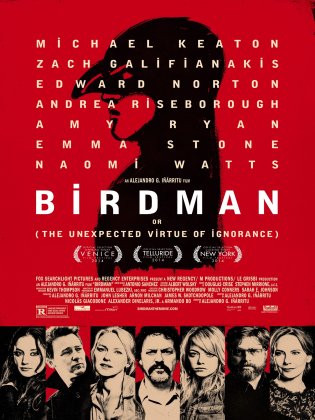
BIRDMAN OR (THE UNEXPECTED VIRTUE OF IGNORANCE) (2014)
Summary:
Riggan Thomson, a washed-up Hollywood actor once famous for portraying the iconic superhero Birdman, grapples with his fading celebrity and an overwhelming sense of artistic irrelevance. In a desperate bid to reclaim his credibility and prove his talent, he risks everything to write, direct, and star in a serious Broadway play based on a Raymond Carver short story. As opening night approaches, Riggan battles his own colossal ego, the relentless, cynical voice of his former superhero persona, and the chaotic personalities of his cast and crew.
The film delves into Riggan's internal and external struggles, blurring the lines between reality and delusion as he navigates the cutthroat world of theater, his strained relationships with his daughter, ex-wife, and fellow actors, and his own perceived telekinetic abilities. It's a darkly comedic and introspective exploration of fame, authenticity, the artistic struggle for relevance, and the profound human need for validation in an increasingly superficial world.
Keywords: Birdman, 2014, Michael Keaton, Edward Norton, Emma Stone, Naomi Watts, Zach Galifianakis, Andrea Riseborough, Amy Ryan, Black Comedy, Drama, Magical Realism, Broadway, Ego, Identity.
Plot:
Riggan Thomson, a former Hollywood star known for playing the titular superhero Birdman in a hugely successful film franchise, finds himself at a precarious crossroads in his life. He is attempting to stage a serious Broadway adaptation of Raymond Carver's short story "What We Talk About When We Talk About Love" as a desperate last-ditch effort to prove his artistic merit and escape the shadow of his blockbuster past. The film opens with Riggan meditating in his dressing room, seemingly levitating, as the gravelly, accusatory voice of Birdman echoes in his mind, mocking his artistic pretensions and urging him to return to the lucrative superhero role. This internal monologue, a constant presence throughout the film, represents Riggan's ego, his past success, and his fear of irrelevance.
The play is plagued by problems from the outset. During a rehearsal, a light fixture falls on an actor, Ralph, prompting Riggan's manager and best friend, Jake, to suggest replacing him. Coincidentally, Riggan's co-star and girlfriend, Laura, suggests Mike Shiner, a notoriously brilliant but volatile method actor, who is also dating another of the play's stars, Lesley. Riggan, initially hesitant, is convinced by Lesley and Jake that Shiner's star power could save the production. Mike Shiner's arrival immediately injects a chaotic energy into the play. He is demanding, arrogant, and constantly challenges Riggan's authority and artistic vision. During their first rehearsal, Mike criticizes Riggan for drinking gin, accusing him of lacking authenticity and commitment to the craft.
Riggan's personal life is equally tumultuous. His daughter, Sam, recently out of rehab for drug addiction, works as his assistant, a role she resents. Their relationship is fraught with tension, as Sam views her father as self-absorbed and obsessed with fame, while Riggan struggles to connect with her. His ex-wife, Sylvia, visits and attempts to offer support, but their conversations reveal the depth of Riggan's past infidelities and the emotional toll his career took on their family. Laura, Riggan's current girlfriend, reveals she might be pregnant, further complicating his already strained emotional landscape.
As previews begin, the friction between Riggan and Mike intensifies. Mike constantly tries to upstage Riggan, improvising lines and demanding changes to the script. During one performance, Mike deliberately sabotages a scene by getting drunk on stage with real gin, causing Riggan to lash out at him backstage. The confrontation escalates, with Mike accusing Riggan of being a fraud and Riggan physically attacking him. The supernatural elements woven into Riggan's reality become more pronounced; he frequently "flies" through the streets of New York, manipulates objects with his mind, and has vivid hallucinations of Birdman, all of which are presented ambiguously, leaving the audience to question their veracity.
The critical reception of the previews is mixed, and Riggan is particularly concerned about the formidable New York Times theater critic, Tabitha Dickinson, known for her harsh reviews. He encounters her at a bar, where she dismissively tells him that she hates Hollywood actors trying to "play" at theater and vows to "kill" his play with a damning review, regardless of its quality. This threat fuels Riggan's paranoia and deepens his resolve to prove her wrong, transforming the play into a battle for his artistic soul.
The night before opening, Riggan experiences a series of escalating breakdowns. He is locked out of the theater in his underwear and is forced to walk through Times Square to get back in. This humiliating ordeal, captured on video, goes viral, paradoxically generating immense buzz for the play. The media, initially dismissive, suddenly takes interest in "Birdman" Riggan Thomson. Later, Sam confronts Riggan in a scathing monologue, accusing him of caring more about being loved and famous than truly living. She points out his irrelevance in the age of social media, where instant validation trumps artistic integrity. This brutal honesty from his daughter deeply wounds Riggan, forcing him to confront his own motivations.
On opening night, the tension reaches its peak. Riggan, still haunted by Birdman's voice, prepares for the performance. In a pivotal moment, he encounters Birdman in his dressing room, who tries to convince him to make another superhero movie. Riggan finally confronts and seemingly defeats the Birdman persona, symbolically destroying his past. During the play's climactic scene, where his character is supposed to commit suicide, Riggan replaces the prop gun with a real one. On stage, he shoots himself in the head. The audience gasps in horror, but the gunshot is depicted as a theatrical flourish, hitting his nose and giving the illusion of a more severe injury. The play ends, and the audience, initially shocked, erupts in a standing ovation.
Riggan is rushed to the hospital. The play is an unexpected triumph, lauded by critics. Tabitha Dickinson, surprisingly, writes a glowing review, praising Riggan's "super-realism" and calling his performance a "new form of theatrical truth." In his hospital room, Riggan talks to Sam and Sylvia. He sees a bird outside his window and, after removing the bandage from his nose, walks to the window. He looks out, a faint smile on his face, before seemingly stepping out. Sam enters the room, looks around for him, then glances out the open window. Her gaze first follows something falling, then slowly lifts upwards, her expression shifting from confusion to wonder, as if watching something ascend into the sky. The film ends on her astonished face, leaving Riggan's fate, and the reality of his "powers," ambiguous.
Cast (Lead Roles):
- Michael Keaton as Riggan Thomson
- Edward Norton as Mike Shiner
- Emma Stone as Sam Thomson
- Naomi Watts as Lesley
- Zach Galifianakis as Jake
- Andrea Riseborough as Laura
- Amy Ryan as Sylvia Thomson
Crew:
- Director: Alejandro G. Iñárritu
- Writers: Alejandro G. Iñárritu, Nicolás Giacobone, Alexander Dinelaris Jr., Armando Bo
- Producers: Alejandro G. Iñárritu, John Lesher, Arnon Milchan, James W. Skotchdopole
- Cinematography: Emmanuel Lubezki
- Film Editing: Douglas Crise, Stephen Mirrione
- Music: Antonio Sánchez
Release Info:
- Original Release Date: October 17, 2014 (United States)
- Language: English
- Genre: Black Comedy, Drama, Magical Realism
- Running Time: 119 minutes
- Accolades: Academy Award for Best Picture, Best Director (Alejandro G. Iñárritu), Best Original Screenplay, Best Cinematography (Emmanuel Lubezki). Nominated for Best Actor (Michael Keaton), Best Supporting Actor (Edward Norton), Best Supporting Actress (Emma Stone), Best Sound Editing, Best Sound Mixing.