


Discription
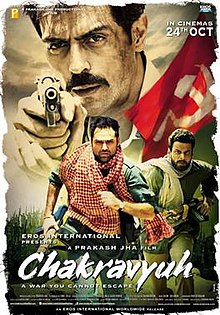
CHAKRAVYUH (2012)
Summary:
Chakravyuh is a hard-hitting Indian political action thriller directed by Prakash Jha, released in 2012. The film delves into the complex and often brutal world of Naxalite-Maoist insurgency in India, exploring the moral ambiguities and the human cost of ideological warfare. It centers on the deep friendship between two men, Adil Khan, a dedicated police officer, and Kabir, a disillusioned idealist. When Adil is tasked with infiltrating a powerful Naxalite group, he convinces Kabir to go undercover, setting off a chain of events that tests their loyalties, principles, and the very fabric of their friendship.
As Kabir embeds himself within the Naxalite movement, he witnesses firsthand the exploitation and injustice suffered by the indigenous tribal communities at the hands of corrupt corporations and state machinery. This exposure gradually transforms his perspective, leading him to sympathize with the Naxalite cause and question the legitimacy of the state he was meant to serve. The film brilliantly portrays the 'chakravyuh' (labyrinth) of violence, corruption, and idealism, where no side is entirely righteous and escape seems impossible, ultimately culminating in a tragic and thought-provoking climax that leaves the audience pondering the cyclical nature of conflict.
Keywords: Chakravyuh, 2012, Arjun Rampal, Abhay Deol, Manoj Bajpayee, Esha Gupta, Political Drama, Action, Thriller, Naxalite, India.
Plot:
The film opens by introducing S.P. Adil Khan (Arjun Rampal), a decorated and upright police officer, and his best friend, Kabir (Abhay Deol), a cynical yet principled young man from a privileged background. Their bond is strong, forged over years of shared experiences. Adil is assigned to a critical mission in Nandighat, a region plagued by Naxalite insurgency, where a powerful Naxalite leader, Rajan (Manoj Bajpayee), has established a formidable stronghold. The Naxalites have been disrupting the operations of Mahanta Industries, a powerful mining corporation led by the ruthless Mahanta (Kabir Bedi), which is exploiting the region's natural resources and displacing its tribal inhabitants with the complicity of local politicians and police.
Adil's superiors, including the seasoned and pragmatic senior officer Govind Suryavanshi (Om Puri), are frustrated by the Naxalites' resilience and the intelligence failures. Adil proposes a daring plan: to infiltrate Rajan's camp with an undercover agent. Given his non-policing background and sharp intellect, Kabir is the ideal candidate. Initially hesitant, Kabir, driven by a desire to help his friend and a sense of adventure, agrees to the dangerous mission. He is trained by Adil in combat and survival skills, preparing him for the harsh realities of the jungle and the Naxalite way of life.
Kabir successfully infiltrates a Naxalite unit, initially posing as a disgruntled youth seeking refuge. He endures brutal initiation rituals and slowly earns the trust of the Naxalites, including the fierce and charismatic female commander, Juhi (Anjali Patil), and the enigmatic Rajan himself. As Kabir spends more time with the Naxalites, he witnesses the deep-seated grievances that fuel their movement. He sees firsthand the abject poverty, the systemic exploitation of tribal communities, the land grabbing by Mahanta Industries, and the brutal repression by corrupt police and government officials. He observes how the Naxalites, despite their violent methods, often act as the only protectors for these marginalized people, providing them with a sense of dignity and justice that the state has denied them.
This exposure begins to chip away at Kabir's initial resolve. He starts questioning the black-and-white narrative he was fed about the Naxalites being mere terrorists. He sees their idealism, their commitment to their cause, and the genuine suffering that drives them. His bond with Juhi deepens, evolving from professional respect to a complex emotional attachment, further complicating his mission. He falls in love with her, blurring the lines between his identity as an undercover agent and his growing empathy for the Naxalite cause.
Meanwhile, Adil is under immense pressure from his superiors to deliver results. His wife, Rhea Menon Khan (Esha Gupta), a fearless journalist, is also covering the Naxalite conflict. Her investigations independently lead her to uncover the same nexus of corruption involving Mahanta Industries, local politicians like MLA Brijmohan (Chetan Pandit), and compromised police officers. Rhea's articles expose the corporate greed and government apathy, inadvertently corroborating the Naxalites' claims and mirroring Kabir's observations from within the movement. This creates a parallel narrative, showing the truth from both sides of the conflict.
As Kabir provides intelligence to Adil, the police launch targeted operations, leading to casualties on both sides. However, Kabir's reports also highlight the Naxalites' legitimate grievances, causing Adil to question the morality of his mission and the state's approach. The emotional toll on both friends is immense. Adil struggles with the knowledge that he is sending his best friend into increasingly dangerous situations, while Kabir grapples with his dual identity and the growing conflict between his loyalty to Adil and his newfound belief in the Naxalite struggle.
The climax builds towards a major Naxalite operation targeting Mahanta Industries, planned by Rajan as a decisive blow against their oppressors. Adil, leveraging Kabir's intelligence, plans a counter-operation to ambush Rajan and his top commanders. The stage is set for a tragic confrontation. Kabir, torn between his friendship with Adil and his loyalty to Juhi and the cause he now believes in, finds himself in an impossible position. During the raid, he makes a crucial decision. Instead of leading Adil's forces to Rajan, he helps the Naxalites escape, effectively betraying his mission and his friend.
In the ensuing chaos, Juhi is gravely injured, and Kabir is forced to confront Adil directly. Their confrontation is emotionally charged, highlighting the irreconcilable differences that have emerged between them. Kabir explains his transformation, his realization that the state is as corrupt and violent as the Naxalites claim, and that he cannot betray people who are fighting for their basic rights. Adil, though heartbroken by Kabir's betrayal, is forced to acknowledge the validity of Kabir's arguments, having witnessed the corruption through Rhea's investigations and his own experiences.
The film ends tragically. Rajan is eventually killed in a subsequent encounter, and Juhi succumbs to her injuries. Kabir, now fully committed to the Naxalite ideology, becomes a leader himself, continuing the fight. Adil, though he has captured/killed the initial targets, realizes that the core issues of injustice and exploitation remain unresolved. The "chakravyuh" of violence and ideology continues, with no clear victor. The film concludes with Adil reflecting on the futility and cyclical nature of the conflict, understanding that peace cannot be achieved through force alone when the root causes of injustice persist, leaving a profound sense of despair and an open-ended question about the future of the region.
Cast (Lead Roles):
- Arjun Rampal as S.P. Adil Khan
- Abhay Deol as Kabir
- Esha Gupta as Rhea Menon Khan
- Manoj Bajpayee as Rajan
- Anjali Patil as Juhi
- Om Puri as Govind Suryavanshi
- Kabir Bedi as Mahanta
- Murali Sharma as Jagmohan
- Chetan Pandit as MLA Brijmohan
- Indraneil Sengupta as Vivek Singh
Crew:
- Director: Prakash Jha
- Writers: Anjum Rajabali, Prakash Jha
- Producers: Prakash Jha, Sunil Lulla, Siddharth Kumar
- Music: Salim-Sulaiman, Aadesh Shrivastava, Sandesh Shandilya
- Cinematography: Sachin Krishn
- Editor: Santosh Mandal
- Production Company: Prakash Jha Productions
- Distributed by: Eros International
Release Info:
- Original Release Date: 24 October 2012
- Language: Hindi
- Genre: Action, Political Drama, Thriller
- Running Time: 152 minutes
- Accolades: N/A