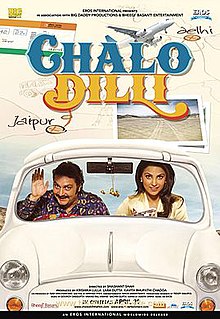


Discription
CHALO DILLI (2011)
Summary:
Chalo Dilli is a delightful Hindi road movie that chronicles the unlikely journey of two contrasting individuals, Mihika Banerjee, a high-flying investment banker, and Manu Gupta, a simple fabric merchant, from Mumbai to Delhi. After missing their flight, the two strangers are forced to travel together through various modes of transport, encountering a series of comical mishaps and heartwarming experiences along the way. Their initial animosity gradually transforms into an unexpected friendship, as the journey forces them to step out of their comfort zones and discover new perspectives on life.
The film brilliantly uses the backdrop of rural India to highlight the vast differences in their personalities and worldviews, ultimately leading to a journey of self-discovery for Mihika and a reaffirmation of life's simple pleasures for Manu. It's a charming tale about finding connection in unexpected places and learning to appreciate the beauty of ordinary life.
Keywords: Chalo Dilli, 2011, Lara Dutta, Vinay Pathak, Road Movie, Comedy, Drama.
Plot:
The story opens by introducing Mihika Banerjee (Lara Dutta), a glamorous, ambitious, and fiercely independent investment banker based in Mumbai. She lives a fast-paced, meticulously planned life, always impeccably dressed and perpetually glued to her phone, navigating the cutthroat world of finance. Her counterpart is Manu Gupta (Vinay Pathak), a jovial, unassuming, and somewhat clumsy fabric merchant from Delhi, who represents the antithesis of Mihika's sophisticated existence. Manu is a man of simple pleasures, deeply rooted in traditional Indian values, and possesses an inherent honesty and optimism that often borders on naiveté. Their paths are destined to collide at the Mumbai airport, where Mihika, en route to Delhi for an important business meeting, finds herself stuck due to a missed flight. Fate, or rather, an overbooked flight, dictates that Manu, also bound for Delhi, is in the same predicament.
The initial encounter is fraught with tension. Mihika, accustomed to five-star comforts, is visibly annoyed by Manu's boisterous demeanor and his attempts to be helpful, which she perceives as intrusive. With all flights to Delhi cancelled and no immediate alternatives, they are left with no choice but to embark on an arduous journey by train. The train journey proves to be a comedic clash of cultures and personalities. Mihika attempts to create a bubble of corporate solitude, working on her laptop and ignoring Manu, who, in his typical fashion, tries to engage her in conversation and offers unsolicited advice. The train's unexpected delay and eventual breakdown in a remote location further exacerbate Mihika's frustration, while Manu, ever the optimist, takes it in stride, finding a way to make the best of a bad situation.
Forced to abandon the train, their journey continues by bus, a local, crowded, and decidedly uncomfortable mode of transport that is a far cry from Mihika's usual luxury. Here, the stark contrast between their worlds becomes even more pronounced. Mihika struggles with the heat, the dust, and the lack of amenities, while Manu, perfectly at home amidst the hustle and bustle, effortlessly interacts with fellow passengers, sharing stories and snacks. The bus journey introduces them to a colorful array of characters, each adding a unique flavor to their escalating adventure. Through these interactions, Mihika slowly begins to witness Manu's genuine kindness and his ability to connect with people from all walks of life, qualities she rarely encounters in her high-stakes corporate world.
The road trip takes an unexpected detour when the bus breaks down, stranding them in a small, dusty town. With no immediate means of transport, they are compelled to spend the night. This unplanned stop becomes a pivotal moment. Mihika, initially horrified by the rustic accommodations and the unfamiliar surroundings, finds herself relying on Manu's street smarts and his ability to navigate the local landscape. They share a meal at a roadside dhaba, where Mihika, initially hesitant to try the local fare, eventually succumbs to its simple charm, a stark contrast to her usual gourmet dining. During this time, they begin to have more personal conversations, slowly peeling back the layers of their public personas. Manu shares anecdotes about his family and his modest dreams, while Mihika, for the first time, reveals glimpses of the pressures and loneliness that come with her demanding career.
As their journey progresses, they stumble upon a local wedding celebration. Manu, with his natural gregariousness, effortlessly blends in, pulling a reluctant Mihika into the festivities. Initially resistant, Mihika finds herself drawn into the vibrant energy of the wedding, dancing and laughing in a way she hasn't in years. This experience is a significant turning point, as it forces her to shed her corporate facade and embrace the unadulterated joy of the moment. She witnesses Manu's unwavering generosity and his ability to find happiness in the simplest of things, a stark contrast to her own constant pursuit of professional success and material possessions. The barriers between them begin to crumble, replaced by a nascent understanding and mutual respect.
Further along their journey, they encounter more challenges and share more intimate moments. A late-night conversation reveals deeper vulnerabilities. Mihika confesses her anxieties about her career, her strained relationship with her family, and the emptiness she sometimes feels despite her achievements. Manu, in turn, shares his own struggles and his unwavering belief in hard work and honesty. These candid exchanges forge a genuine bond, allowing them to see beyond each other's stereotypes. Mihika starts to appreciate Manu's sincerity, his resourcefulness, and his innate goodness, while Manu learns about the silent pressures that burden Mihika, hidden beneath her polished exterior.
The remaining leg of their journey is marked by a growing sense of camaraderie and comfort. The bickering subsides, replaced by shared laughter and quiet understanding. They look out for each other, Manu offering practical help and Mihika, in turn, offering a rare smile or a word of genuine appreciation. They navigate various modes of transport, from tractors to jeeps, each segment of the journey further solidifying their unexpected friendship. The road itself becomes a metaphor for their personal growth, with each stop and detour offering a new lesson and a deeper insight into themselves and each other.
Finally, they arrive in Delhi. The bustling city, their original destination, now feels secondary to the journey they have shared. The moment of parting is bittersweet, marked by an unspoken acknowledgment of the profound impact they have had on each other's lives. Mihika, no longer the rigid, self-absorbed executive, offers Manu a genuine hug, a gesture that speaks volumes about her transformation. She has learned to appreciate the simple joys, the warmth of human connection, and the beauty of ordinary life, lessons she could never have learned in a boardroom. Manu, ever the steadfast and kind soul, is enriched by the experience, his belief in human goodness reaffirmed.
The film concludes with Mihika returning to her high-flying corporate life, but with a visibly changed perspective. She is still the astute businesswoman, but now she carries a newfound lightness, a greater appreciation for the world around her, and a deeper understanding of what truly matters. Chalo Dilli is more than just a road trip; it's a journey of self-discovery, a heartwarming testament to the power of unexpected friendships, and a reminder that sometimes, the most profound lessons are learned when we step outside our comfort zones and embrace the unpredictable path.
Cast (Lead Roles):
- Lara Dutta as Mihika Banerjee
- Vinay Pathak as Manu Gupta
Crew:
- Director: Shashant Shah
- Producers: Krishika Lulla, Lara Dutta, Mahesh Bhupathi
- Writers: Shashant Shah (Screenplay), Arshad Sayed (Story & Screenplay)
- Music: Anand Raj Anand, Sachin Gupta
- Cinematography: S. Bharathwaaj
- Editor: Suresh Pai
Release Info:
- Original Release Date: April 29, 2011
- Language: Hindi
- Genre: Comedy, Drama, Road Movie
- Running Time: 118 minutes
- Accolades: Critically acclaimed for its fresh concept, humorous narrative, and strong performances, particularly by Vinay Pathak.