


Discription
CHILLAR PARTY (2011)
Summary:
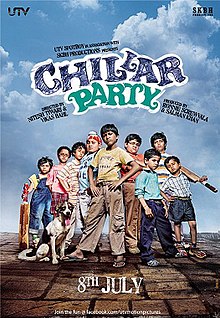
Chillar Party is a heartwarming and humorous Hindi film that delves into the lives of a group of mischievous but good-hearted children from a Mumbai housing society. Their carefree existence, filled with games and innocent adventures, is dramatically altered with the arrival of Fatka, an orphaned street boy, and his loyal stray dog, Bhidu. Initially prejudiced and wary of the "outsiders," the children gradually shed their inhibitions and form an unbreakable bond with Fatka and Bhidu, embracing them as part of their exclusive "Chillar Party."
However, their newfound friendship is threatened when a local politician, Mr. Dubey, targets Bhidu as part of an opportunistic election campaign against stray animals. Faced with a municipal order to remove Bhidu, the children find themselves up against the bureaucratic system and the often-indifferent adult world. Unwilling to abandon their friend, the "Chillar Party" launches a unique and spirited protest, using their innocence, creativity, and collective will to challenge the status quo, fight for compassion, and ultimately, stand up for their unconventional family. The film is a poignant and funny exploration of childhood innocence, social responsibility, and the extraordinary power of collective action against injustice.
Keywords: Chillar Party, 2011, Children, Comedy, Drama, Friendship, Social Commentary, Nitesh Tiwari, Vikas Bahl, Sanath Menon, Irfaan Khan.
Plot:
The story opens by introducing a vibrant and self-contained world of eight young boys residing in a bustling Mumbai housing society. They call themselves the "Chillar Party," a moniker reflecting their carefree, slightly chaotic, and fiercely independent spirit. Each boy possesses a distinct personality: there's Lanky, the unofficial leader; Akram, the agile cricketer; Secondhand, who always has a used item for sale; Shaolin, the martial arts enthusiast; Encyclopaedia, the walking knowledge bank; Aflatoon, the romantic; Panauti, the perpetually unlucky one; and Silencer, the quiet observer. Their days are filled with cricket matches, elaborate pranks, secret meetings on their terrace "adda," and a general disdain for the adult world's rules. They live in a bubble of privilege and comfort, largely oblivious to the struggles outside their society walls.
Their insulated world is abruptly breached by the arrival of Fatka, an orphaned street boy who washes cars for a living, and his scruffy but fiercely loyal stray dog, Bhidu. Fatka lives under a flyover, his only companion being Bhidu, and his life is a stark contrast to the Chillar Party's sheltered existence. When Fatka and Bhidu start appearing around the society, the Chillar Party's initial reaction is one of fear, disgust, and prejudice. They see Fatka as "dirty," an "outsider," and Bhidu as a dangerous nuisance. They try various childish tactics to scare them away, throwing stones and shouting insults, reinforcing the social divide that separates their worlds.
The turning point in their relationship comes gradually, sparked by a series of small but significant incidents. During a cricket match, the Chillar Party finds themselves a player short. Reluctantly, they allow Fatka to join, only to be surprised by his exceptional cricketing skills, particularly his ability to hit sixes. This shared passion for the game begins to chip away at their prejudices. Later, Bhidu, despite being a stray, proves his loyalty and gentle nature, perhaps by protecting one of the boys from an aggressive adult or by simply being a comforting presence when one of them is upset. The boys begin to observe Fatka's quiet dignity and his deep, unconditional love for Bhidu. They witness his resilience and resourcefulness, qualities they admire despite their initial judgment. Slowly, almost imperceptibly, the walls between them begin to crumble.
As the boys spend more time with Fatka and Bhidu, a profound friendship blossoms. Fatka, initially an outcast, is fully embraced into the Chillar Party. They share their snacks, their secrets, and their dreams. Bhidu becomes the unofficial mascot of their group, a silent guardian and a source of comfort. The boys learn about empathy, compassion, and the true meaning of friendship, realizing that their differences in background are superficial compared to the bonds of shared experiences and mutual respect. Their understanding of the world expands beyond the confines of their society, and they start to see the injustice and hardship that Fatka faces daily.
However, their idyllic new friendship is soon threatened by the opportunistic machinations of Mr. Dubey, a local politician with an upcoming election. Sensing a populist issue, Dubey decides to launch a campaign against stray dogs, portraying them as a menace to public safety and hygiene. Bhidu, being a visible stray in the society, becomes the unwitting target and symbol of Dubey's campaign. A municipal notice is issued, ordering the removal of all stray dogs from the area, with Bhidu specifically mentioned. The Chillar Party is devastated. The thought of losing Bhidu, and by extension, seeing Fatka heartbroken and alone again, is unbearable.
The children turn to the adults in their lives for help, expecting them to understand and intervene. But they are met with a mixture of indifference, practical concerns, and even veiled support for Dubey's stance. Parents dismiss their pleas, citing "rules" and "public safety," or simply tell them to let it go, fearing the trouble their children might stir up. The Chillar Party feels betrayed by the adult world, which seems more concerned with convenience and political expediency than with compassion and justice. It is at this point that the children realize they are on their own and must take matters into their own hands.
Fueled by their unwavering loyalty to Fatka and Bhidu, the Chillar Party makes a collective decision to fight back. They decide that they will not let Bhidu be taken away without a struggle. This marks their transformation from a group of mischievous kids into a force for change. After much deliberation and a brainstorming session, they come up with an unconventional and attention-grabbing protest idea: the "Chaddi March," or the Underpants Protest. Their logic is simple yet brilliant: protesting in their underwear will be so embarrassing and absurd that it will inevitably grab media attention and force the adults to take notice of their cause.
The execution of the Chaddi March is a comedic and powerful highlight of the film. The boys, shedding their inhibitions along with their clothes, march through their society in their underwear, chanting slogans like "Chaddi pehen ke jayenge, Bhidu ko bachayenge!" (We'll go in our underpants, we'll save Bhidu!). The sight of these determined children in their briefs shocks, amuses, and embarrasses the adults, just as they intended. The local media, always on the lookout for a quirky story, quickly picks up on the unique protest, propelling the Chillar Party and their cause into the public spotlight. The Chaddi March becomes a symbol of innocent defiance against adult apathy and bureaucratic rigidity.
Mr. Dubey, initially dismissive, soon realizes that the children's protest is gaining traction and negatively impacting his election campaign. He attempts various tactics to quell their rebellion: he tries to bribe them with gifts, intimidate them with threats, and even attempts to manipulate public opinion against them. However, the Chillar Party, now united and resolute, refuses to back down. Their simple honesty and unwavering conviction prove to be more powerful than Dubey's political maneuvering. Their parents, initially hesitant, begin to witness the sincerity and courage of their children, and some even start to offer cautious support.
The issue escalates, becoming a city-wide debate. The Chillar Party, guided by Encyclopaedia's knowledge and Lanky's leadership, learns to navigate the complexities of bureaucracy and media. They write letters to authorities, give interviews to journalists, and organize further peaceful protests, each one more creative than the last. They learn about civic rights, the power of public opinion, and the importance of standing up for what is right. Their innocence allows them to cut through political rhetoric and present their case with an emotional honesty that resonates with the public.
The climax of the film arrives in the form of a public hearing or debate, where the Chillar Party directly confronts Mr. Dubey and the municipal authorities. It's a tense and emotional showdown. The children, despite their age, articulate their arguments with surprising clarity and conviction, emphasizing the bond between humans and animals, the importance of compassion, and the arbitrary nature of laws that separate friends. Fatka's testimony, delivered with heartfelt sincerity about Bhidu being his only family, is particularly poignant and moves many in the audience. The children's collective voice, backed by growing public support, creates an undeniable force.
In a triumphant resolution, the Chillar Party's efforts pay off. They win their battle; Bhidu is allowed to stay, and the municipal order is overturned or modified. Mr. Dubey's political ambitions are dealt a significant blow, as his opportunistic campaign backfires. More importantly, the community, initially divided, comes to understand the deeper message of the children's fight – one of empathy, co-existence, and challenging unjust systems. The victory is not just for Bhidu but for the principles of humanity and compassion that the children so passionately championed.
The film concludes with Fatka fully integrated into the society, no longer an outsider but a cherished member of the community and the Chillar Party. The boys, having matured significantly through their experience, continue their adventures, but with a newfound understanding of the world and their place in it. They have learned that even the smallest voices can make a big difference when united by a common cause. The bond between them and Bhidu is stronger than ever, a testament to their unwavering friendship and the power of their collective spirit. Chillar Party leaves the audience with a heartwarming message about the innocence of childhood, the strength of friendship, and the potential for positive social change, even when driven by a group of determined kids.
Cast (Lead Roles):
- Sanath Menon as Lanky
- Rohan Grover as Akram
- Naman Jain as Jhangiya (Secondhand)
- Aarav Khanna as Shaolin
- Vishesh Tiwari as Encyclopaedia
- Chinmay Chandraunshuh as Aflatoon
- Vedant Desai as Panauti
- Divij Handa as Silencer
- Irfaan Khan as Fatka
- Bhidu as Himself (The dog)
- Rajesh Sharma as Mr. Dubey
Crew:
- Directors: Nitesh Tiwari, Vikas Bahl
- Producers: Ronnie Screwvala, Siddharth Roy Kapur, Salman Khan (Presenter)
- Writers: Nitesh Tiwari, Vikas Bahl (Screenplay), Nitesh Tiwari (Dialogue)
- Music Director: Amit Trivedi
- Cinematography: Avinash Arun
- Editor: Chandan Arora
- Production Company: UTV Motion Pictures, Salman Khan Being Human Productions
Release Info:
- Original Release Date: July 8, 2011
- Language: Hindi
- Genre: Comedy, Drama, Children's Film
- Running Time: 136 minutes
- Accolades: National Film Award for Best Children's Film, National Film Award for Best Screenplay (Nitesh Tiwari & Vikas Bahl), National Film Award for Best Child Artist (for the entire group of child artists).