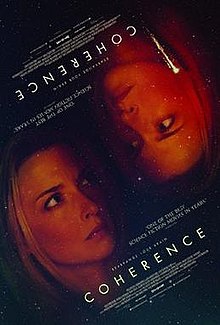



Discription
Coherence (2013) is a mind-bending science fiction thriller that delves into quantum mechanics, parallel realities, and the fragility of human perception. Directed by James Ward Byrkit, the film follows a seemingly normal dinner party that takes a terrifying turn when a cosmic anomaly disrupts reality itself.
The movie begins with Emily (Emily Baldoni), a woman struggling with personal decisions, particularly about her long-distance relationship and an opportunity to move to another country. She arrives at a dinner party hosted by Mike (Nicholas Brendon) and Lee (Lorene Scafaria), along with her boyfriend Kevin (Maury Sterling) and their friends Hugh (Hugo Armstrong), Amir (Alex Manugian), Beth (Elizabeth Gracen), and Laurie (Lauren Maher). The evening is meant to be a casual gathering, but there is an underlying tension, especially between Laurie and Emily, as Laurie is Kevin’s ex-girlfriend.
As the group settles in, they discuss the peculiar phenomenon of a comet named Miller's Comet, which is passing close to Earth that night. The conversation turns eerie when Hugh mentions a story his physicist brother told him about strange events occurring when a similar comet passed decades ago. Supposedly, people experienced memory lapses, and in one instance, a woman saw a duplicate of herself.
Soon, inexplicable occurrences begin. The first major disruption happens when the power goes out, leaving only a single house on the street illuminated. Hugh and Amir decide to investigate and head towards the lit house. Upon their return, they are visibly shaken and bring back a mysterious box containing photographs of the group members, some with numbers written on the back. This discovery unsettles everyone, as they cannot comprehend how or why these photographs exist.
As the night progresses, the group starts experiencing discrepancies in their reality. They notice inconsistencies in their conversations, objects shifting, and even minor changes in each other’s behaviors. A horrifying realization dawns on them—there are multiple versions of themselves existing in different parallel realities, each version originating from a different timeline affected by the comet’s influence.
Tensions rise when they discover that by stepping outside their house, they risk crossing into an alternate version of their reality. Emily, Kevin, Mike, and the others struggle to understand whether they are still in their original timeline or if they have unknowingly switched into another one. Paranoia sets in as they suspect impostors among themselves, leading to conflicts and distrust.
Mike, who is already dealing with past struggles of alcoholism and career failure, starts unraveling under pressure. He becomes aggressive and unhinged, proposing drastic actions to determine who belongs to which reality. His descent into paranoia only exacerbates the chaos within the group.
Meanwhile, Emily realizes that she cannot trust the people around her, nor can she be sure of her own identity anymore. She stumbles upon an alternate version of the house where she finds another version of herself. Overwhelmed by fear and desperation, she makes a drastic decision—to eliminate her alternate self and take her place in what she perceives as a more favorable reality.
Emily drugs her other self and drags her body away, assuming the alternate Emily’s identity. She returns inside, pretending nothing happened, but as the comet’s influence wanes, cracks in her fabricated reality begin to show. The final moment of the film is chilling—Kevin, unaware of the switch, answers a phone call, only to hear Emily’s voice on the other end, revealing that her attempt to secure a perfect reality may have failed.
Coherence is a film that masterfully blends psychological tension with high-concept science fiction. Its exploration of quantum decoherence and the Many-Worlds Interpretation creates an atmosphere of relentless uncertainty. The use of improvisational dialogue and a minimalist approach to special effects amplifies the feeling of realism, making the film all the more unsettling.
Ultimately, Coherence leaves the audience questioning the nature of reality and identity. The film’s ambiguous ending suggests that no reality is truly stable, and the possibility of infinite versions of oneself existing simultaneously is both fascinating and terrifying. In its quiet, intimate setting, the movie achieves a level of existential horror that lingers long after the credits roll.