


Discription
DHOBI GHAT (2011)
Summary:
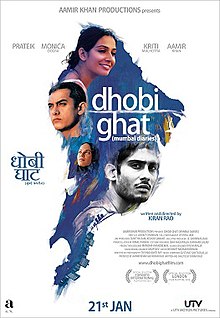
Dhobi Ghat, also known internationally as "Mumbai Diaries," is a poignant Indian drama film that intricately weaves together the lives of four disparate characters in the sprawling metropolis of Mumbai. Directed by Kiran Rao in her directorial debut, the film explores themes of loneliness, connection, observation, and the city itself as a living entity. At its core, it tells the story of Arun, a reclusive painter who discovers a set of video diaries left behind by a former tenant, Yasmin, becoming deeply engrossed in her life story.
Parallel to Arun's voyeuristic journey, the film introduces Shai, an Indian-American photographer who befriends Arun and finds herself drawn to Munna, a charming dhobi (washerman) with aspirations of becoming a Bollywood actor. Munna, in turn, is Arun's delivery boy, creating an indirect link between all four characters. The narrative unfolds through their individual perspectives, offering a raw and intimate glimpse into their desires, frustrations, and the complex tapestry of Mumbai life, where personal stories often remain unseen or unheard.
Keywords: Dhobi Ghat, 2011, Aamir Khan, Monica Dogra, Prateik Babbar, Kriti Malhotra, Drama, Mumbai.
Plot:
Dhobi Ghat opens with Arun, a reclusive and somewhat melancholic painter, moving into a new, sparsely furnished apartment in Mumbai. He is struggling with a creative block, his canvases often left unfinished, reflecting an inner turmoil and a detachment from the bustling city outside his window. His days are marked by solitude, punctuated by brief interactions with his friends and the quiet observation of his surroundings. One day, while rummaging through his new home, he discovers a set of three video cassettes left behind by the apartment's previous occupant. Curiosity piqued, he decides to watch them.
The tapes reveal themselves to be a video diary kept by a young woman named Yasmin, who had recently moved to Mumbai after an arranged marriage. Yasmin, speaking directly to the camera, recounts her experiences, her hopes, and her growing sense of isolation in the unfamiliar city. She describes her husband, a seemingly kind but often absent man, and her attempts to adapt to her new life, from learning to cook to navigating the crowded streets. Her narrative is a poignant and often heartbreaking account of a woman trying to find her place and voice in a new world, documenting the mundane details of her daily existence – the sounds, the sights, the smells of Mumbai – through her lens. Arun, initially a detached observer, becomes increasingly captivated by Yasmin's story, feeling an inexplicable connection to her vulnerability and her unspoken longing.
Meanwhile, the film introduces Shai, an Indian-American investment banker on a sabbatical, who has returned to Mumbai to pursue her passion for photography. Shai is independent, curious, and seeks to capture the authentic, often gritty, essence of Mumbai beyond its glamorous facade. She is friends with Arun, and their relationship is marked by a casual intimacy, though Arun often appears emotionally distant. Shai hires Munna, a charming and resourceful young dhobi (washerman) who also serves as a local guide for tourists and runs errands, to help her navigate the city's hidden corners and lesser-known locales. Munna, a dreamer with aspirations of becoming a Bollywood actor, is instantly drawn to Shai's vivacity and artistic spirit. He practices his acting lines in front of her, often with a self-deprecating humor that endears him to her.
As Shai spends more time with Munna, exploring the dhobi ghats (open-air laundries), the bustling markets, and the cramped residential areas, she develops a crush on him. She is fascinated by his simple yet ambitious life, his unwavering optimism despite his humble circumstances. She captures his world through her camera, seeing a beauty and resilience that others might overlook. Munna, however, seems oblivious to her romantic interest, viewing her more as a patron and a friend, his focus primarily on his acting dreams and the daily grind of his work. Their interactions are a delicate dance of unspoken desires and cultural differences, highlighting the chasm that exists between their two worlds.
The narrative continues to interweave these three primary perspectives. Arun continues his deep dive into Yasmin's tapes. He learns about her increasing loneliness, her husband's emotional distance, and her growing despair. Yasmin's video diary transforms from a simple record of daily life into a raw confession of her inner turmoil, her feelings of being trapped and unseen. Arun begins to feel a profound empathy for her, almost as if he is living vicariously through her experiences. Her voice, her expressions, and her growing sadness become a haunting presence in his solitary apartment, stirring emotions within him that he previously kept suppressed.
Munna, the common thread, continues to navigate his dual life. He diligently picks up and delivers laundry, including Arun's, and guides Shai through the labyrinthine streets of Mumbai. He is a survivor, constantly hustling, but also a romantic at heart, dreaming of stardom. He sees Mumbai as a city of opportunities, a place where dreams can come true, even as he grapples with the harsh realities of poverty and social stratification. His interactions with Arun are brief and transactional, yet Arun observes him, perhaps seeing a reflection of his own artistic yearning in Munna's acting aspirations.
As the film progresses, Yasmin's tapes reach a devastating climax. In her final entries, her despair becomes overwhelming, culminating in a tragic revelation that shatters Arun's detached observation. He is left profoundly shaken, feeling the weight of her lost life and the intimacy of her shared pain. The tapes force him to confront his own isolation and the human need for connection, even if it's with someone he has never met. The experience acts as a catalyst, subtly shifting his perspective and perhaps even reigniting his artistic impulse, though the film leaves this ambiguous.
Shai's journey also reaches a poignant point. Her unrequited feelings for Munna remain unacknowledged, and she comes to terms with the transient nature of their connection. She accepts that their worlds, despite their brief overlap, are fundamentally different. Her photographs, however, serve as a testament to her experience, a visual diary of her own exploration of Mumbai and the human connections she forged, however fleeting. Munna, ever the optimist, continues to pursue his acting dreams, his spirit unbroken by the city's challenges, embodying the relentless hope that defines many of Mumbai's residents.
Dhobi Ghat is not a film about direct intersections or a grand resolution. Instead, it's a mosaic of lives in Mumbai, connected by circumstance and a shared urban landscape, yet often isolated in their individual journeys. The city itself acts as a powerful, almost fifth character – vibrant, indifferent, brutal, and beautiful all at once. The film beautifully captures its chaotic energy, its stark contrasts, and its ability to simultaneously foster connection and anonymity. It's a meditation on observation, voyeurism, and the silent stories that unfold daily within a metropolis, leaving the audience to ponder the countless unseen lives that intertwine around them.
Cast (Lead Roles):
- Aamir Khan as Arun
- Monica Dogra as Shai
- Prateik Babbar as Munna
- Kriti Malhotra as Yasmin (voice/tapes)
Crew:
- Director: Kiran Rao
- Producer: Aamir Khan
- Writer: Kiran Rao
- Music (Background Score): Gustavo Santaolalla
- Music (Songs): Ram Sampath
- Cinematography: Tushar Kanti Ray
- Editor: Hemanti Sarkar
Release Info:
- Original Release Date: January 21, 2011
- Language: Hindi, English
- Genre: Drama
- Running Time: 102 minutes
- Accolades: Premiered in the 'Special Presentations' section at the 2010 Toronto International Film Festival.