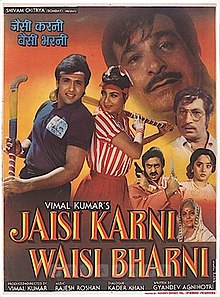


Discription
JAISI KARNI WAISI BHARNII (1989)
Summary:
Jaisi Karni Waisi Bharnii is a powerful social drama from 1989 that meticulously explores the timeless adage of karma, demonstrating how every action, good or bad, inevitably returns to its doer. The film centers on the stark contrast between the virtuous, hardworking farmer Ramu and the avaricious, ruthless moneylender Seth Dharamdas. Through a series of escalating injustices and heart-wrenching struggles, the narrative vividly portrays Dharamdas's relentless exploitation of the impoverished villagers, particularly Ramu and his family, and the profound suffering it inflicts.
As Dharamdas's empire of deceit and cruelty grows, seemingly unchallenged, the film patiently builds towards an inevitable reckoning. It showcases Ramu's unwavering spirit and moral fortitude in the face of immense adversity, juxtaposed with the gradual, yet devastating, unraveling of Dharamdas's life and legacy, directly caused by his own malevolent deeds. The story culminates in a poignant and satisfying climax where justice, though delayed, is ultimately served, reaffirming the enduring principle that one truly reaps what one sows, leaving a lasting impression on the audience about the sanctity of righteousness and the futility of greed.
Keywords: Jaisi Karni Waisi Bharnii, 1989, Dharmendra, Hema Malini, Amrish Puri, Drama, Social, Moral, Karma, Retribution.
Plot:
The story of Jaisi Karni Waisi Bharnii unfolds in the picturesque yet struggling village of Shantipura, where life is dictated by the rhythms of the seasons and the shadow of the tyrannical moneylender, Seth Dharamdas. Ramu, a young, honest farmer, embodies the spirit of the village – hardworking, principled, and deeply devoted to his aging father, Kishanlal, and his beloved sister, Radha. Ramu's world revolves around his small plot of land, passed down through generations, and his blossoming love for Sita, a kind-hearted girl from a neighboring farm. Their dreams are modest: a good harvest, a happy family, and a life free from the clutches of debt.
However, Seth Dharamdas, a man whose heart is as barren as the parched earth he covets, casts a long, dark shadow over Shantipura. Dharamdas is a ruthless opportunist, known for his cunning schemes and his insatiable hunger for wealth and power. He lends money at exorbitant interest rates, manipulates land deeds, and exploits the villagers' desperation, slowly but surely seizing their ancestral properties. His son, Vijay, a weak-willed young man, is torn between his father's corrupt influence and a nascent sense of morality, often finding himself a reluctant participant in Dharamdas's machinations, yet too afraid to openly defy him. The film's inciting incident occurs when a severe drought cripples Shantipura, leaving the farmers, including Ramu, unable to repay their loans. Dharamdas sees this as his golden opportunity, demanding immediate repayment or the forfeiture of their lands. Ramu, desperate to save his family's heritage, pleads for an extension, but Dharamdas, with a cruel smirk, refuses.
Dharamdas's cruelty escalates when he fraudulently acquires Ramu's land, claiming a fabricated default on a loan. Ramu's father, Kishanlal, a man of immense pride and dignity, is devastated by the loss of their land, the very soul of their family. The shock proves too much for his frail heart, and he passes away, leaving Ramu consumed by grief and a burning desire for justice. Ramu tries to seek legal recourse, but Dharamdas's deep pockets and corrupt connections within the local administration ensure that all avenues for justice are blocked. The village, too, is helpless, having witnessed similar injustices for years. In a further act of callousness, Dharamdas sets his sights on Radha, Ramu's sister, attempting to coerce her into marriage with his crude and drunken nephew, purely to consolidate his control over the remaining villagers and further humiliate Ramu. Ramu, with Sita's unwavering support, bravely thwarts this attempt, leading to a public confrontation that solidifies Dharamdas's hatred for him.
Ramu, now landless and burdened by his father's death and his sister's safety, refuses to succumb to despair. He finds work as a laborer in a nearby town, saving every rupee, while Sita and Radha support each other. Meanwhile, Dharamdas's empire continues to grow, built on the tears and toil of the villagers. He expands his business, investing in mills and factories, often using unethical means to maximize profits. He becomes even more arrogant and isolated, alienating even those who once supported him out of fear. His son, Vijay, witnesses his father's increasing ruthlessness and the widespread suffering it causes. A chance encounter with Ramu, now a respected and honest worker in the town, and seeing his genuine struggle, begins to stir a conscience within Vijay. He starts questioning his father's methods, leading to heated arguments and a growing rift between them.
The turning point arrives when Dharamdas, in his relentless pursuit of wealth, embarks on a scheme to build a dam that would divert vital irrigation water from Shantipura to his own commercial farms, effectively destroying the remaining agricultural land of the village. This plan, if executed, would render the entire village barren and force the remaining farmers into destitution. Ramu, learning of this through his network of sympathetic contacts, realizes he must act. He returns to Shantipura, rallying the villagers, who, though initially fearful, are now emboldened by Ramu's courage and their shared desperation. Vijay, witnessing his father's ultimate betrayal of his own community, finally breaks free from his father's influence and decides to help Ramu, providing crucial evidence of Dharamdas's illegal land acquisitions and environmental violations related to the dam project.
The climax unfolds dramatically during the inauguration ceremony of Dharamdas's new dam. Ramu, armed with Vijay's evidence and supported by the united villagers, confronts Dharamdas publicly, exposing his decades of deceit, exploitation, and the catastrophic impact his dam project would have. The local authorities, now unable to ignore the overwhelming evidence and public outcry, are forced to intervene. Dharamdas, caught in his own web of lies, attempts to flee, but his escape is thwarted by the very villagers he had oppressed. In a symbolic act of poetic justice, a sudden, torrential downpour, a divine intervention mirroring the "jaisi karni waisi bharnii" theme, causes the hastily constructed, poorly engineered dam to crack and collapse, washing away Dharamdas's illicit wealth and symbols of his power.
In the aftermath, Dharamdas is arrested, his reputation shattered, his wealth gone, and his empire in ruins. His son, Vijay, though saddened by his father's downfall, finds redemption in his actions and dedicates himself to helping the villagers. Ramu, with the support of Sita and the grateful community, leads the efforts to rebuild Shantipura. The land is returned to its rightful owners, and Ramu, once a victim, becomes a beacon of hope and justice. The film concludes with the villagers celebrating a bountiful harvest, a testament to their resilience and the triumph of good over evil, leaving the audience with the powerful message that while the wheels of justice may turn slowly, they turn surely, ensuring that every individual ultimately faces the consequences of their actions, both good and bad.
Cast (Lead Roles):
- Dharmendra as Ramu
- Amrish Puri as Seth Dharamdas
- Hema Malini as Sita
- Sanjay Dutt as Vijay
- Pran as Kishanlal (Ramu's Father)
Crew:
- Director: Rajkumar Kohli
- Producer: G.P. Sippy
- Music Director: Laxmikant-Pyarelal
- Writer: Sachin Bhowmick
- Cinematographer: V.K. Murthy
Release Info:
- Original Release Date: July 7, 1989
- Language: Hindi
- Genre: Drama, Social, Moral
- Running Time: 165 minutes
- Accolades: Nominated for Best Story at the Filmfare Awards.