

Discription
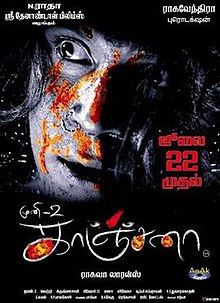
Kanchana (also known as Muni 2: Kanchana) tells the story of Raghava, a timid and unemployed young man plagued by an intense fear of ghosts (phasmophobia), and his accidental entanglement with the vengeful spirit of a transgender woman named Kanchana. The film blends horror, comedy, and social commentary, exploring themes of prejudice, injustice, and the fight for retribution.
Raghava’s crippling fear dominates his life. He refuses to leave his house after dark, insists on sleeping in his mother Sarala’s room, and even requires her to accompany him to the bathroom at night. His behavior disrupts the lives of his family, including his widowed mother, his elder brother Prasad, Prasad’s wife Kamakshi, and their children.
Raghava and his friends, who regularly play cricket on a local ground, are forced to find a new playing field due to upcoming construction. They unknowingly choose an abandoned plot of land, rumored to be haunted. During their attempt to set up a cricket pitch, an unusual weather change forces them to abandon the area. Unbeknownst to Raghava, his cricket stumps become stained with blood after piercing buried corpses on the land.
Meanwhile, Raghava is pursuing a romantic interest in Kamakshi’s younger sister, Priya, who has come to stay with the family. At the same time, Sarala and Kamakshi become increasingly disturbed by strange occurrences in their home, which they suspect are of a supernatural nature. They keep these incidents secret from the rest of the family and consult a priest.
The priest advises them to perform three specific rituals to confirm the presence of a spirit. To prevent Raghava from interfering, Sarala and Kamakshi send him, Priya, and the children to Kamakshi’s maternal home under the pretext of checking on Kamakshi’s ailing father. The rituals confirm their worst fears: a malevolent presence resides in their home. They hire two priests, who promise to exorcise the spirit. However, these “priests” are revealed to be con men who take the family’s money and flee after staging a fake exorcism.
Raghava, Priya, and the children return home the next day, unaware of the events that have transpired. That very night, Raghava becomes possessed by the ghost. From that moment on, Raghava’s personality undergoes a dramatic transformation. He begins to act in an effeminate manner, distancing himself from Priya. In a particularly embarrassing incident at a shopping complex, Raghava wears a saree and women’s jewelry, causing his mother considerable shame.
The situation takes a dark turn when Raghava, while possessed, murders a woman named Madhavi and disposes of her body without anyone’s knowledge. Kamakshi witnesses Raghava behaving strangely, wearing her bangles, and reveals his unusual behavior to Prasad. The family confronts Raghava, and they discover that he is possessed by not one, but three spirits: a woman, an Urdu-speaking Muslim, and an autistic man.
Terrified, the family seeks the help of a Muslim exorcist. The exorcist manages to temporarily drive the spirits out of Raghava’s body, forcing the woman’s spirit to reveal her identity. She identifies herself as Kanchana, a transgender woman, and recounts her tragic past.
Kanchana’s story is one of hardship and injustice. Disowned by her parents after they discovered her gender identity, she was taken in by a kind Muslim man named Akbar Bhai, who had an autistic son. Kanchana, unable to pursue her own dream of becoming a doctor due to the prejudice she faced, dedicated herself to supporting her adopted daughter, Geetha, another transgender woman, in her medical studies. Geetha eventually secured a scholarship to study abroad. Kanchana used her savings to purchase a plot of land, intending to build a hospital for the poor.
However, her dreams were shattered when a corrupt MLA named Shankar illegally seized her land for his mistress, Madhavi. When Kanchana and Akbar Bhai confronted Shankar, he brutally murdered them both and forced Akbar’s autistic son to commit suicide. He then buried their bodies on the very land he had stolen.
Back in the present, the exorcist, while sympathetic to Kanchana’s plight, is bound by his duty to contain her spirit. However, Raghava, having heard her story, understands the injustice she suffered and voluntarily allows her to re-possess him. Using Raghava’s body, Kanchana seeks revenge on Shankar and his henchmen.
The confrontation culminates at a Narasimha temple, a place where spirits are traditionally unable to enter. Kanchana prays to the deity, pleading for permission to enter and deliver justice. Her plea is answered, and she is granted access to the temple. Inside, she confronts Shankar and kills him in a manner reminiscent of how Narasimha killed Hiranyakashipu in Hindu mythology, tearing him apart.
The film’s epilogue shows Raghava, Priya, and their family attending the inauguration ceremony of the hospital built on the reclaimed land, fulfilling Kanchana’s dream. As the ceremony proceeds, some local thugs arrive, attempting to extort money. At that moment, Kanchana re-possesses Raghava, signaling her continued presence and willingness to return whenever justice needs to be served. Kanchana is a story of vengeance, but it also sheds light on the struggles faced by marginalized communities and the enduring power of the human spirit.