

Discription
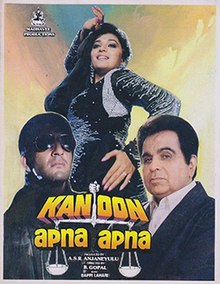
KANOON APNA APNA (1989)
Summary:
Kanoon Apna Apna is a powerful Hindi action-drama from 1989 that explores the complex themes of justice, law, and morality through the eyes of a father and son. Inspector Jagmohan Singh, a retired and disillusioned police officer, has lost faith in the legal system after witnessing powerful criminals repeatedly escape justice. He believes that when the law fails, one must take matters into their own hands to ensure justice prevails.
In stark contrast, his son, Inspector Arjun Singh, is an idealistic and upright young cop who firmly believes in upholding the law, even when faced with overwhelming corruption. Their ideological clash forms the core of the narrative as Arjun battles the ruthless crime lord Jabbar, while Jagmohan secretly transforms into a vigilante to deliver the justice the system cannot. The film delves into the moral dilemmas faced by both father and son, leading to a climactic confrontation that tests their beliefs and their bond.
Keywords: Kanoon Apna Apna, 1989, Dilip Kumar, Sanjay Dutt, Madhuri Dixit, Nutan, Kader Khan, Action, Drama, Law, Justice, Vigilante.
Plot:
The film opens by introducing Inspector Jagmohan Singh (Dilip Kumar), a once-esteemed and upright police officer now living a life of quiet retirement, but burdened by profound bitterness and disillusionment. His career, though marked by integrity, ended with the painful realization that the legal system he swore to uphold was often powerless against the rich and influential criminals who manipulated it with ease. He firmly believes that the law is a mere puppet in the hands of the powerful, and true justice can only be achieved when individuals are willing to bypass the flawed system and take matters into their own hands. His wife, Lakshmi (Nutan), a woman of immense strength and compassion, tries to soothe his cynicism, but Jagmohan's convictions run deep.
Into this household steps their son, Arjun Singh (Sanjay Dutt), a newly appointed police inspector, brimming with youthful idealism and an unshakeable faith in the rule of law. Arjun is everything his father once was, but without the scars of disillusionment. He believes that every crime must be met with due legal process, and that upholding the law, no matter how challenging, is the only path to a just society. This fundamental ideological chasm creates an immediate and palpable tension between father and son. Jagmohan watches his son's fervent idealism with a mixture of pride and cynical foreboding, knowing the heartbreak that awaits him in the corrupt world of law enforcement.
The primary antagonist of the story is Jabbar (Kader Khan), a formidable and ruthless crime lord who controls a vast criminal empire. Jabbar operates with audacious impunity, his influence extending deep into the political and judicial systems. He routinely bribes politicians, police officials, and even judges, making a mockery of justice and rendering the law utterly ineffective against his operations. His network is extensive, his henchmen numerous, and his presence casts a long shadow of fear over the city. Arjun, in his very first assignments, inevitably crosses paths with Jabbar’s syndicate. He is shocked by the sheer audacity of their crimes and their blatant disregard for legal authority. His initial attempts to bring Jabbar’s men to justice are met with frustrating failures; witnesses are intimidated or disappear, crucial evidence vanishes, and the criminals are often released on bail or acquitted due to lack of proof or political pressure. Each failure reinforces Jagmohan’s cynical worldview and chips away at Arjun’s unwavering faith.
Amidst his professional frustrations and the escalating conflict with Jabbar, Arjun finds solace and strength in his burgeoning romance with Radha (Madhuri Dixit). Radha is a vibrant, spirited, and compassionate young woman who becomes a vital source of emotional support for Arjun. She encourages him to uphold his ideals despite the overwhelming odds and the systemic corruption he faces daily. Their love blossoms, providing Arjun with a much-needed respite from the harsh realities of his work. However, their relationship also raises the stakes significantly, as Radha's proximity to Arjun makes her a potential target for Jabbar's wrath, adding another layer of danger to Arjun's already perilous life.
Jabbar’s criminal activities escalate, plunging the city into deeper fear and chaos. His empire expands into drug trafficking, extortion, and even political assassinations, further demonstrating his unchallenged power. A particular incident occurs that deeply affects Arjun – perhaps a close friend or an innocent family is brutally victimized by Jabbar’s gang, and once again, the legal system fails to deliver justice. This event pushes Arjun to the brink, forcing him to question his own unwavering faith in the law, much to Jagmohan’s silent observation. Jagmohan, witnessing his son’s struggle and the continued mockery of justice, feels his old wounds reopen. His belief that the law is a mere puppet in the hands of the powerful is solidified, and he decides that it's time for a different kind of justice.
Driven by his deep-seated conviction that justice must prevail, even if it means operating outside the legal framework, Jagmohan decides to take matters into his own hands. He adopts a new, masked identity, transforming into a vigilante who metes out swift, brutal justice to Jabbar’s men. He targets the very criminals who escaped Arjun’s arrests, creating a wave of fear within Jabbar’s syndicate and a mysterious wave of vigilante justice across the city. The public, disillusioned with the police and the corrupt system, begins to hail this unknown avenger as a hero, while the police department, including Arjun, is tasked with identifying and apprehending him. This creates an ironic and dangerous situation where Arjun is sworn to capture the very person who is delivering the justice he so desperately seeks.
Arjun finds himself in a profound moral quagmire. While he understands the public’s frustration and, deep down, secretly approves of the vigilante’s results, his duty as a police officer compels him to stop this extra-legal activity. He begins an earnest investigation into the vigilante, gathering clues, interviewing witnesses, and trying to piece together the identity of this mysterious figure. Slowly, subtly, the clues begin to point towards someone familiar. The fighting style, the impeccable timing of the attacks, the intimate knowledge of Jabbar’s operations – all these elements start to coalesce, leading Arjun to a horrifying and deeply unsettling suspicion: could his own father be the vigilante? This suspicion creates immense internal conflict for Arjun, as he grapples with the potential reality of having to arrest his own father for upholding the very justice they both seek, albeit through radically different means.
Jabbar, now facing a relentless two-pronged attack from the persistent police inspector (Arjun) and the mysterious vigilante (Jagmohan), becomes increasingly desperate and dangerous. He plans a major, audacious crime, perhaps targeting Radha or a significant public event, to reassert his dominance and draw out his unknown adversary. Arjun, having confirmed his suspicions about his father's dual identity, races against time to stop Jabbar while also trying to protect Jagmohan from exposing himself or getting killed in the escalating conflict. The climax unfolds in a dramatic, high-octane showdown where Arjun, Jagmohan (still in his vigilante persona), and Jabbar’s entire gang converge. Amidst the chaos of battle, the vigilante's identity is revealed, leading to a powerful emotional confrontation between father and son, who find themselves fighting side-by-side against a common enemy.
In the ensuing battle, father and son, despite their ideological differences, unite their forces to bring down Jabbar and his criminal empire. Jabbar is finally brought to justice, either killed or arrested, effectively dismantling his reign of terror. The film concludes with a nuanced resolution of the ideological conflict. Arjun, while still believing in the law, has gained a deeper understanding of its limitations and the inherent human desire for immediate justice when the system fails. Jagmohan, having achieved his goal and seen his son fight for justice with unwavering dedication, might come to appreciate the enduring importance of a functioning legal system, even if imperfect. The film leaves the audience with a powerful message about the complexities of justice, the fine line between law and morality, and the enduring bond between a father and son who, despite their differing paths, ultimately share the same profound goal: a just and equitable society.
Cast (Lead Roles):
- Dilip Kumar as Inspector Jagmohan Singh
- Nutan as Lakshmi Singh
- Sanjay Dutt as Inspector Arjun Singh
- Madhuri Dixit as Radha Singh
- Kader Khan as Jabbar
- Ranjeet as John
Crew:
- Director: B. Gopal
- Producers: B.R. Chopra, Ravi Chopra
- Story: M.D. Sunder
- Screenplay: C.J. Dixit
- Dialogue: C.J. Dixit, M.D. Sunder
- Music Director: Bappi Lahiri
- Cinematography: K.M. Venkat
- Editor: B.S. Ganesh
Release Info:
- Original Release Date: 11 August 1989
- Language: Hindi
- Genre: Action, Drama
- Running Time: 160 minutes
- Accolades: None significant