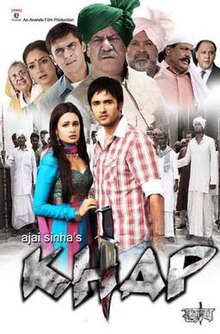



Discription
KHAP (2011)
Summary:
Khap is a poignant Hindi drama film from 2011 that courageously delves into the harrowing issue of honor killings perpetrated by traditional Khap panchayats in rural India. The narrative centers on a young, educated couple, Madhur and Vir, who fall in love and marry in Delhi, only to face the wrath and brutal judgment of their village's Khap panchayat upon their return. Their transgression, in the eyes of the Khap, is marrying within the same 'gotra' (lineage), a practice deemed incestuous and forbidden by ancient customs, despite being perfectly legal under Indian law.
The film powerfully portrays the agonizing dilemma of Madhur's father, Omkar Singh, a respected village elder and Khap member, who is torn between his profound love for his daughter and his lifelong allegiance to the rigid traditions of his community. Featuring a stellar cast including Suneil Shetty, Yuvika Chaudhary, Anurag Sinha, Om Puri, and Govind Namdev, "Khap" serves as a stark commentary on the clash between modern individual rights and deeply entrenched, often violent, societal norms, exposing the devastating consequences of such archaic practices on innocent lives.
Keywords: Khap, 2011, Suneil Shetty, Yuvika Chaudhary, Om Puri, Honor Killing, Khap Panchayat, Indian Drama, Social Issue.
Plot:
The narrative of "Khap" unfolds against the backdrop of contemporary India, beginning in the bustling, anonymous metropolis of Delhi. Here, Madhur (Yuvika Chaudhary) and Vir (Anurag Sinha), two bright and ambitious young students, find love and companionship. Their romance blossoms away from the conservative gaze of their rural hometowns, allowing them to forge a connection based on mutual affection and shared dreams. Unaware of the ancient, rigid customs that still hold sway in the villages they hail from, they decide to marry, believing their love to be a bond that transcends all differences.
Their joyous return to their ancestral villages, eager to share their happiness with their families, marks the turning point in their lives. Madhur's father, Omkar Singh (Suneil Shetty), is a figure of considerable respect and authority in his village. As a prominent sarpanch (village head) and an influential member of the local Khap panchayat, he embodies the traditional values of his community. Initially, Omkar welcomes Vir with warmth, seeing him as a suitable and educated match for his beloved daughter. However, this initial warmth quickly turns to chilling dread.
News of Madhur and Vir's marriage soon reaches the ears of the Khap panchayat elders. It is then that a devastating truth, unknown and irrelevant to the young couple in Delhi, comes to light: Madhur and Vir, despite belonging to different villages, share the same 'gotra' – a patrilineal clan or lineage. According to the archaic and unyielding rules enforced by the Khap, marriage within the same 'gotra' is considered an act of incest, a profound violation of sacred tradition, and an unforgivable sin, even though such unions are perfectly legal under India's civil laws. This revelation shatters the couple's dreams and plunges their families into a terrifying crisis.
Sardar Singh (Govind Namdev), the formidable and unyielding head of the Khap panchayat, swiftly declares Madhur and Vir's marriage null and void. His pronouncements are absolute, his authority rarely questioned by the villagers who live under his pervasive influence. He perceives their union not merely as a transgression but as a direct challenge to the entire community's honor and the sanctity of its age-old traditions. Rallying the other elders, Sardar Singh orchestrates a public decree, condemning the young couple, initiating their social ostracization, and subtly, yet menacingly, putting their lives in grave peril.
Omkar Singh finds himself trapped in an unbearable moral quandary. On one side stands his deep paternal love for Madhur, whose happiness is being cruelly extinguished. On the other, his lifelong allegiance to the Khap's traditions, which have granted him respect, power, and identity within his community. The immense pressure of social boycott and the terrifying repercussions for his family weigh heavily on his conscience. He attempts to reason with Sardar Singh and the other elders, pleading for leniency, explaining the couple's ignorance of their 'gotra' connection. However, his pleas fall on deaf ears; the Khap's judgment is final, asserting that such a transgression cannot be tolerated, lest it erode their authority and set a dangerous precedent.
Madhur and Vir, though terrified, refuse to surrender their love and the legality of their marriage. They seek external intervention, appealing to the police and the formal legal system. This brings SP Fateh Singh (Om Puri), an upright and principled police officer, into the volatile situation. SP Fateh Singh is well aware of the Khap's oppressive practices and has often found himself in direct conflict with their parallel system of justice. He attempts to intervene, asserting the supremacy of Indian law over the Khap's dictates and striving to offer protection to Madhur and Vir. However, his efforts are met with cunning resistance, intimidation, and outright defiance from the Khap elders, who wield significant local power and influence over the fearful villagers, often coercing potential witnesses or supporters into silence.
The situation rapidly escalates. The Khap panchayat convenes a larger assembly, publicly shaming Madhur and Vir and declaring a social boycott against anyone who dares to support them, effectively isolating the couple completely. Threats of violence become increasingly explicit, culminating in chilling hints of the ultimate punishment: honor killing. Omkar's friend, Sukhi (Manoj Pahwa), a more pragmatic villager, attempts to caution Omkar, urging him to prioritize his daughter's life above all else, even if it means defying the Khap. Sukhi, however, is also paralyzed by fear of challenging the established order.
Omkar's internal struggle reaches its breaking point. He witnesses the brutal public humiliation of his daughter and the relentless, merciless pursuit of Vir. He begins to see the hypocrisy and inherent cruelty behind the Khap's rigid adherence to tradition, realizing that it values an abstract concept of 'honor' far above human life and genuine love. Perhaps, memories of a past tragedy, a similar incident involving a close family member, resurface, fueling his growing disillusionment. He desperately tries to find a way to save Madhur and Vir without completely alienating himself from his community, but the Khap leaves him no room for negotiation or compromise.
Under Sardar Singh's relentless leadership, the Khap panchayat convenes its final, chilling assembly. The verdict is pronounced: Madhur and Vir must be "punished" to restore the village's honor. The unspoken, yet universally understood, consequence is death. SP Fateh Singh, alerted to the imminent danger, mobilizes his forces, but the Khap's deep-rooted influence and the villagers' fear make it challenging for him to act swiftly and decisively without provoking a larger, potentially violent confrontation.
In the harrowing climax, Omkar Singh is forced to make a choice that will irrevocably define him. He must decide whether to stand by and allow his daughter and her husband to be brutally murdered in the name of a barbaric tradition, or to defy the very system he has upheld his entire life. Fueled by an overwhelming paternal love and a newfound conviction against the gross injustice, Omkar makes his stand. He confronts Sardar Singh and the Khap, potentially even physically protecting Madhur and Vir. This courageous act of defiance unleashes chaos. The film culminates in a tragic but profoundly powerful confrontation. While the exact outcome for Madhur and Vir might vary, often reflecting the grim realities of such situations, Omkar's transformation and defiance are central. He might sacrifice himself, or he might succeed in protecting them, but not without immense personal cost. SP Fateh Singh's timely arrival often provides a fragile moment of legal intervention, but the film ultimately serves as a stark commentary on the deep-seated societal challenge posed by Khap panchayats. The ending does not offer easy answers but rather a grim reflection of a harsh reality, where love and life are frequently sacrificed at the altar of misguided tradition, leaving the audience to ponder the true meaning of honor and justice.
Cast (Lead Roles):
- Suneil Shetty as Omkar Singh
- Yuvika Chaudhary as Madhur
- Anurag Sinha as Vir
- Om Puri as SP Fateh Singh
- Govind Namdev as Sardar Singh
- Manoj Pahwa as Sukhi
Crew:
- Director: Ajai Sinha
- Producers: Ajai Sinha, Satish Singh
- Writer (Screenplay): Ajai Sinha
- Writer (Dialogue): Anand Prakash
- Music: Sukhwinder Singh
- Cinematography: Krishna Ramanan
- Editor: Sandeep Singh
Release Info:
- Original Release Date: 29 July 2011
- Language: Hindi
- Genre: Drama, Social, Thriller
- Running Time: 125 minutes
- Accolades: None widely publicized