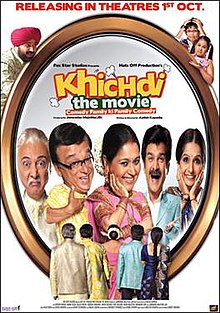


Discription
KHICHDI: THE MOVIE (2010)
Summary:
Khichdi: The Movie takes the beloved, eccentric Parekh family from the popular Indian television series onto the big screen for an even grander, more uproarious adventure. The film centers around the youngest son, Himanshu, a man of boundless enthusiasm and questionable intellect, who suddenly decides he wants to become a film director. This outlandish ambition sets the stage for a series of chaotic and hilarious events as the entire family, against their better judgment and much to Babuji's exasperation, gets dragged into Himanshu's cinematic vision.
From a nonsensical script written by Himanshu and translated by Praful for Hansa's literal mind, to the desperate search for funding and the utterly disastrous filming process, the movie is a rollercoaster of the Parekh family's signature brand of endearing madness. It's a heartwarming yet side-splitting portrayal of family unity, where despite constant bickering, misunderstandings, and a complete lack of common sense, their love and loyalty to each other always shine through, culminating in a film that is as uniquely flawed and lovable as the family itself.
Keywords: Khichdi The Movie, 2010, Supriya Pathak, Rajeev Mehta, Anang Desai, Vandana Pathak, Jamnadas Majethia, Comedy, Family, Bollywood.
Plot:
The film opens by reintroducing the audience to the perpetually chaotic and endearing Parekh family, residing in their sprawling ancestral home. Babuji, the patriarch, continues his daily struggle for peace amidst the cacophony created by his family. His son Praful, simple-minded and literal, constantly translates his wife Hansa's equally literal and nonsensical questions. Jayshree, the sharp-tongued daughter-in-law, revels in stirring up trouble and providing sarcastic commentary. And then there's Himanshu, the youngest, a dreamer whose ideas are as grand as they are impractical.
The central premise kicks off when Himanshu, after watching a particularly bad movie, has an epiphany: he decides he wants to become a film director. His reasoning, as usual, is completely illogical – if such a bad movie can be made, surely he can make a good one. The family, naturally, is aghast. Babuji dismisses it as another one of Himanshu's fleeting, foolish fancies. Jayshree immediately sees an opportunity for drama and gossip, while Praful and Hansa, in their typical fashion, misunderstand the entire concept, with Hansa repeatedly asking, "Praful, film kya hota hai?" (Praful, what is a film?).
Undeterred by the family's skepticism, Himanshu plunges headfirst into his new passion. His first task is to write a script. This process itself is a comedic masterpiece. Himanshu, with his limited grasp of storytelling, weaves a convoluted tale that is a distorted reflection of their own lives, filled with bizarre plot twists, nonsensical dialogue, and characters with names like "Chakki" and "Chikki" (played by the actual Chakki and Chikki of the family). Hansa, listening in, interprets everything literally, offering equally absurd suggestions, which Praful diligently translates, further complicating the already muddled narrative. For instance, if Himanshu describes a dramatic scene, Hansa might interject asking if the characters will get a tea break during the emotional outburst.
The next monumental hurdle is funding. Himanshu needs money to turn his "masterpiece" into a reality. Babuji, ever the miser, vehemently refuses to invest a single rupee in what he considers a guaranteed disaster. Jayshree, always resourceful, suggests various outlandish schemes to raise money, some of which involve trying to pawn off family heirlooms, others involving dubious business ventures that inevitably go wrong. They approach various wealthy, equally quirky individuals, leading to hilarious encounters where the Parekh family's unique brand of chaos scares off potential investors. Eventually, through a combination of Himanshu's relentless persuasion, Jayshree's cunning, and Babuji's reluctant surrender, a meager budget is cobbled together, mostly from family savings and small loans from equally eccentric relatives.
With a script (of sorts) and a budget (however small), Himanshu moves to casting. His vision, naturally, involves casting his own family members in pivotal roles. This leads to a series of disastrous "auditions." Hansa is cast as the tragic heroine, but her acting consists solely of her usual mannerisms and literal interpretations, much to Himanshu's exasperation. Praful, playing the hero, delivers his lines with the same deadpan sincerity he uses for translating Hansa's queries. Babuji, forced into a supporting role, constantly complains about the waste of time and money, delivering his lines with an air of profound annoyance. Jayshree, of course, is a natural at playing the conniving villain, adding her own sarcastic flair to every scene. Himanshu's love interest, Parminder, also gets a role, struggling to make sense of Himanshu's peculiar directorial style.
The actual filming process is where the true comedic genius of the Parekh family shines. Their ancestral home is transformed into a makeshift film set, much to Babuji's chagrin. Every scene is a monumental struggle. Himanshu's direction is chaotic and often contradictory. He yells instructions that make no sense, demanding emotions that Hansa cannot comprehend beyond her literal understanding. "Hansa, show sadness!" he might instruct, only for Hansa to ask, "Praful, sadness kya hota hai? Kya main roke dikhaun?" (Praful, what is sadness? Should I cry and show it?). Praful's attempts to "act" involve repeating his lines with a vacant stare, while Jayshree offers a running commentary of the absurdity, often breaking character to mock Himanshu or Hansa.
Technical blunders are rampant. The amateur crew, often consisting of equally incompetent friends or relatives, makes every mistake imaginable – microphones visible in shots, cameras out of focus, lighting failures, and sound issues. Props constantly break, sets collapse, and the entire production is a testament to perseverance in the face of utter incompetence. One memorable scene might involve a dramatic chase sequence filmed within the confines of their living room, leading to furniture being knocked over and Babuji's prized possessions getting damaged, further fueling his ire.
Amidst the chaos, the budding romance between Himanshu and Parminder provides a brief respite of genuine emotion, though even their interactions are often punctuated by Himanshu's single-minded focus on his film. Parminder, a relatively normal individual, tries her best to support Himanshu while gently attempting to inject some semblance of logic into his creative process, usually to no avail.
The climax builds towards the completion of the film, a miraculous feat given the circumstances. The family, exhausted but united, prepares for a private screening. The anticipation is palpable, mixed with a healthy dose of dread. The screening itself is a riot. The audience, consisting of other eccentric family members and a few brave friends, reacts with a mixture of confusion, bewildered laughter, and occasional genuine amusement at the sheer audacity of Himanshu's vision. The film is a technical and narrative disaster, a mishmash of genres, continuity errors, and unintentionally hilarious moments.
However, despite the film's undeniable lack of quality, the Parekh family finds a strange sense of accomplishment. The movie, for all its flaws, is uniquely "Himanshu," and by extension, uniquely "Parekh." It's a testament to their unwavering support for each other, even when one of them embarks on the most ridiculous of endeavors. The film might not win any awards or break box office records, but it serves as a powerful reminder of their unbreakable bond. The movie concludes with Himanshu, ever the dreamer, already contemplating his next "masterpiece," much to the despair and affectionate exasperation of his family, affirming that the chaos and love in the Parekh household will continue indefinitely.
Cast (Lead Roles):
- Supriya Pathak as Hansa Praful Parekh
- Rajeev Mehta as Praful Tulsidas Parekh
- Anang Desai as Babuji (Tulsidas Parekh)
- Vandana Pathak as Jayshree Bharat Parekh
- Jamnadas Majethia as Himanshu Tulsidas Parekh
- Kirti Kulhari as Parminder Singh
- Nimisha Vakharia as Jigna
- Deepak Pareek as Raju
- Arya Rawal as Chakki
- Richa Bhadra as Chikki
Crew:
- Director: Aatish Kapadia
- Writer: Aatish Kapadia
- Producers: Jamnadas Majethia, Aatish Kapadia
- Music Director: Raju Singh
- Cinematography: Manoj Gupta
- Editor: Steven H. Bernard
Release Info:
- Original Release Date: October 1, 2010
- Language: Hindi
- Genre: Comedy, Family
- Running Time: 130 minutes
- Accolades: Popular extension of a beloved TV series, celebrated for its unique humor and character portrayals.