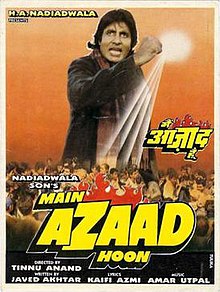


Discription
MAIN AZAAD HOON (1989)
Summary:
Main Azaad Hoon is a powerful Hindi social drama film from 1989 that delves into the ethics of journalism, the power of media, and the voice of the common man. The story centers on a frustrated and idealistic journalist, Hari Prasad, who, disillusioned by the apathy of society and the sensationalism of the press, invents a fictional character named "Azaad" (meaning "free"). Azaad is portrayed as a fearless, anonymous voice speaking out against corruption, injustice, and the exploitation of the poor.
What begins as a journalistic experiment to stir public consciousness quickly escalates into a nationwide phenomenon. Azaad becomes a symbol of hope and defiance, leading Hari Prasad into a complex web of moral dilemmas as his creation takes on a life of its own, challenging both the establishment and his own integrity. The film explores the thin line between truth and fabrication, the responsibility of the media, and the collective power of a united populace, all while questioning what it truly means to be free in a society grappling with systemic issues.
Keywords: Main Azaad Hoon, 1989, Amitabh Bachchan, Social Drama, Journalism, Media, Satire.
Plot:
The film opens by introducing Hari Prasad (Amitabh Bachchan), a seasoned and idealistic journalist working for a prominent newspaper. Hari is deeply troubled by the rampant corruption, social injustice, and the general apathy he observes in society. He feels that the media, including his own paper, often sensationalizes trivial matters while failing to address the fundamental problems plaguing the common people. His frustration boils over during a heated discussion with his editor, who dismisses his plea for more meaningful reportage, citing market demands and public interest in lighter fare. Hari, feeling stifled and unheard, believes that the public has lost its voice and its courage to speak up against the powerful.
Driven by a desperate urge to ignite a spark of change, Hari conceives a radical idea: to invent a fictional character named "Azaad" (meaning "free" in Hindi). Azaad is envisioned as an anonymous, fearless common man who dares to speak the truth, challenge the corrupt, and inspire the downtrodden. Hari begins writing a column under Azaad's name, presenting him as a mysterious figure who appears in different guises, delivering powerful, hard-hitting speeches against social evils, political corruption, and economic disparity. These initial articles are designed to provoke thought and encourage public discourse, criticizing specific injustices and calling for collective action. Hari meticulously crafts Azaad's persona, ensuring his words resonate with the frustrations and hopes of the average citizen.
To Hari's surprise, Azaad's column is an instant sensation. The public, starved for a genuine voice of dissent and hope, embraces Azaad with unprecedented enthusiasm. People start discussing Azaad's articles, quoting his lines, and even forming small groups to act upon his calls for change. The newspaper's circulation skyrockets, and Azaad becomes a national phenomenon. However, the immense popularity brings its own set of challenges. The editor, initially skeptical, now wants more of Azaad, pushing Hari to produce content that lives up to the growing public expectation. Hari finds himself under increasing pressure to keep the charade going, constantly inventing new scenarios and speeches for Azaad, fearing that the truth about his creation would shatter the nascent hope he has inadvertently kindled.
The situation escalates dramatically when a powerful industrialist, deeply implicated in a corruption scandal exposed by Azaad, offers a hefty reward for anyone who can reveal Azaad's true identity. This act of desperation by the establishment only strengthens Azaad's image as a formidable opponent of injustice. The public's belief in Azaad grows stronger, bordering on reverence. People start attributing various anonymous acts of defiance and charity to Azaad, turning him into a mythical figure. Hari, witnessing the profound impact of his creation, feels a mix of pride, fear, and moral conflict. He sees the good Azaad is doing but is tormented by the deception at its core. He confides in his friend and colleague, Subhash (Manohar Singh), who initially supports his unconventional approach but later begins to question the ethics of maintaining such a grand illusion.
The political landscape also takes notice. Azaad's popularity becomes a political hot potato. While some politicians try to appropriate Azaad's message for their own gain, others, particularly those targeted by Azaad's criticisms, view him as a dangerous revolutionary figure inciting unrest. The government, under pressure, launches an investigation to unmask Azaad, suspecting him to be a real individual operating underground. Hari finds himself constantly evading suspicion, carefully maintaining his journalistic facade while secretly being the architect of a nationwide movement. He experiences moments of profound joy when he sees people genuinely inspired by Azaad to stand up for themselves, but these are always overshadowed by the heavy burden of his secret.
The climax of the film revolves around a massive public rally organized by the people, demanding Azaad to reveal himself and lead them. The pressure on Hari becomes unbearable. The public's faith is so absolute that they are unwilling to accept anything less than Azaad's physical presence. Hari is torn between revealing the truth and crushing the hopes of millions, or continuing the lie and risking exposure. In a moment of intense introspection and moral reckoning, Hari decides that Azaad, the idea, is more important than Hari Prasad, the man. He realizes that Azaad is no longer just his creation; he has become a collective symbol, a voice that the people have chosen for themselves.
At the rally, Hari, disguised and hidden among the crowd, orchestrates a final, dramatic act. He arranges for a series of events and messages to be delivered, maintaining the illusion that Azaad is present but choosing to remain anonymous to protect the movement. He delivers a powerful, emotional speech through a surrogate, explaining that Azaad is not a single person but rather the collective conscience of every individual who dares to speak up against injustice. Azaad is in every person who fights for freedom and truth. This symbolic act allows the idea of Azaad to transcend the physical, becoming an eternal spirit of defiance. Hari makes it clear that the power lies not in one individual, but in the united voice of the people. The film concludes with the understanding that while Hari Prasad may have created Azaad, Azaad truly belongs to the people, living on as an idea and an inspiration for future generations to demand accountability and fight for their rights. The film leaves the audience with a powerful message about the enduring spirit of freedom and the responsibility of each individual to embody the change they wish to see.
Cast (Lead Roles):
- Amitabh Bachchan as Hari Prasad / Azaad (Voice)
- Shabana Azmi as Suhasini
- Anupam Kher as Editor
- Manohar Singh as Subhash
- K.K. Raina as Chaurasia
Crew:
- Director: Tinnu Anand
- Producer: Sibte Hasan Rizvi
- Writer: Javed Akhtar (Screenplay & Dialogue), Tinnu Anand (Story)
- Music Director: Amar Utpal
- Cinematography: B. Lakshman
- Editor: R. Rajendran
Release Info:
- Original Release Date: February 3, 1989
- Language: Hindi
- Genre: Social Drama, Satire, Thriller
- Running Time: 155 minutes
- Accolades: While not a major award winner, the film received critical acclaim for its bold subject matter, strong performances, and thought-provoking message, earning recognition as a significant work in Indian social cinema.