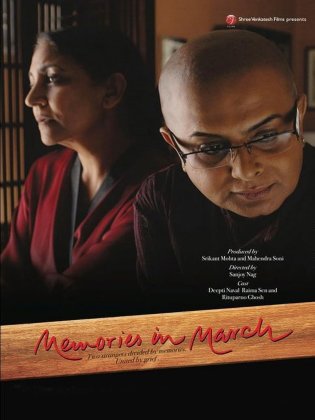



Discription
MEMORIES IN MARCH (2010)
Summary:
Memories in March is a poignant Indian drama directed by Sanjoy Nag, exploring themes of grief, discovery, and acceptance. The film centers on Arati S. Mishra, a middle-aged mother who travels to Kolkata following the sudden death of her son, Siddhartha, in a car accident. As she navigates the unfamiliar world her son inhabited, staying in his apartment and interacting with his colleagues and friends, Arati slowly uncovers a profound truth about Siddhartha's life and identity that challenges her preconceived notions and forces her to confront her own understanding of love and family.
The narrative unfolds primarily through Arati's perspective, a conservative woman grappling with immense loss, as she pieces together the fragments of her son's hidden life. Her journey is one of quiet revelation, guided by Siddhartha's business partner, Suresh, and his close friend, Sohini. The film is celebrated for its sensitive portrayal of a mother's evolving grief and her eventual, albeit difficult, acceptance of her son's homosexuality, offering a nuanced look at parental love and societal expectations in the face of personal truth.
Keywords: Memories in March, 2010, Deepti Naval, Rituparno Ghosh, Raima Sen, Drama, Grief, Acceptance, Homosexuality, India.
Plot:
The film opens with Arati S. Mishra (Deepti Naval), a dignified, middle-aged woman, arriving in Kolkata, her face etched with a profound sorrow. She has flown from Delhi to attend to the aftermath of her son, Siddhartha's, untimely death in a car accident. The weight of her grief is palpable as she is driven to Siddhartha's apartment, a space that feels both intimately connected to her son and yet utterly foreign to her. She is met by Sohini (Raima Sen), Siddhartha's colleague and friend, who is gentle and helpful, but whose presence only further underscores the stark reality of Siddhartha's absence.
Arati settles into the apartment, a place filled with her son's belongings, each object a silent testament to a life she thought she knew intimately, yet now feels shrouded in mystery. Her initial interactions are strained, a mix of profound sadness and the practicalities of dealing with a deceased loved one's estate. She meets Suresh (Rituparno Ghosh), Siddhartha's business partner, who seems to be handling most of the arrangements. Suresh is soft-spoken, attentive, and incredibly supportive, constantly anticipating Arati's needs and offering comfort. Arati initially perceives him as a loyal friend and dedicated business associate of her son, grateful for his presence during such a difficult time.
As days turn into a week, Arati begins to notice subtle discrepancies and unusual details within the apartment and in her interactions. She finds a stack of clothes, freshly laundered, folded neatly, and placed in a drawer – an act of domesticity that seems out of character for her son, whom she knew to be less meticulous. She observes Suresh's deep familiarity with the apartment, his easy navigation of its spaces, and his intuitive understanding of Siddhartha's preferences, from his choice of tea to the books on his shelf. There's a quiet intimacy in Suresh's demeanor, a tenderness in his voice when he speaks of Siddhartha, which begins to prick at Arati's subconscious.
One evening, Arati discovers a particular book on Siddhartha's bedside table – a collection of essays on gender and sexuality, including works by Virginia Woolf, with passages subtly highlighted. This discovery, coupled with a growing sense of unease, plants the first seed of doubt in her mind. She recalls fragments of conversations, the way Suresh would sometimes linger a little too long, the unspoken glances shared between him and Sohini when Siddhartha was mentioned. Sohini, seemingly a potential romantic interest in Arati's eyes, appears to be aware of a deeper truth, her expressions often conveying a quiet understanding that Arati cannot yet grasp.
The apartment itself becomes a character, slowly revealing its secrets. Arati finds a framed photograph of Siddhartha and Suresh, their postures relaxed, their smiles genuine, radiating a warmth that goes beyond mere friendship. She notices a shared mug, a pair of slippers that aren't Siddhartha's size but are frequently worn by Suresh. These small, seemingly insignificant details accumulate, forming a mosaic of a life that Arati was entirely unaware of. Her grief begins to intertwine with a profound sense of bewilderment and a growing, unsettling curiosity.
The emotional tension builds as Arati's observations become too numerous to ignore. She begins to actively seek answers, though her inquiries are often indirect, tinged with a conservative sensibility that struggles to articulate the unspoken. She probes Sohini, asking about Siddhartha's personal life, his relationships, his plans. Sohini, caught between loyalty to Siddhartha's memory and compassion for Arati's pain, offers carefully worded responses, hinting at a complexity that Arati is not yet ready to accept. Sohini's character represents a younger generation's more open understanding of sexuality, contrasting with Arati's traditional worldview.
The inevitable confrontation arrives, not as an explosive revelation, but as a quiet, heart-wrenching exchange. Arati confronts Suresh, perhaps not with direct accusations, but with a desperate plea for understanding. She asks him about the nature of his relationship with Siddhartha, the unasked question hanging heavy in the air. Suresh, recognizing her profound need for truth, gently and with immense sadness, confirms what Arati has been slowly piecing together: he and Siddhartha were partners, deeply in love, and had shared a life together in that very apartment. He speaks of their bond, their shared dreams, and the quiet joy they found in each other's company.
This revelation shatters Arati's world. Her son, whom she had always envisioned leading a conventional life, marrying a woman, and having children, had a secret life, a love that society often deemed unacceptable. The initial shock gives way to a torrent of emotions: confusion, anger, a sense of betrayal, and an overwhelming sadness not just for his death, but for the life she never knew he lived. She grapples with societal prejudices, her own conservative upbringing, and the painful realization that a significant part of her son remained unknown to her. She retreats into herself, struggling to reconcile the Siddhartha she knew with the Siddhartha Suresh describes.
The film delves into Arati's internal struggle, portraying her journey towards acceptance. She revisits her memories of Siddhartha, now re-evaluating past interactions, conversations, and his general demeanor through the lens of this new information. She begins to understand the subtle cues she might have missed, the unspoken anxieties, the quiet strength her son possessed. Suresh, despite Arati's initial shock and withdrawal, remains a steadfast presence, his grief mirroring hers, his understanding of Siddhartha's essence perhaps even deeper. He shares anecdotes, memories, and insights that help Arati to see her son not as a secret-keeper, but as a man who found love and happiness on his own terms.
As the days in March draw to a close, Arati begins to heal, not just from the loss of her son, but from the shock of his identity. She witnesses the depth of Suresh's love for Siddhartha, a love as profound and genuine as any she had ever known. She understands that love transcends gender, societal norms, and her own expectations. The film culminates in a quiet, powerful moment of reconciliation. Arati, having processed her grief and come to terms with the truth, offers Suresh a gesture of acceptance – perhaps a shared meal, a comforting touch, or a simple acknowledgment of their shared loss and love for Siddhartha. She leaves Kolkata with a changed heart, carrying not just the sorrow of her son's death, but also a newfound understanding and an expanded capacity for love, having finally come to know and accept the full, complex truth of her son's life and his "Memories in March."
Cast (Lead Roles):
- Deepti Naval as Arati S. Mishra
- Rituparno Ghosh as Suresh
- Raima Sen as Sohini
- Mahesh Dattani as Siddhartha Chowdhury (voice/photograph)
Crew:
- Director: Sanjoy Nag
- Writer: Rituparno Ghosh (dialogue), Sanjoy Nag (story, screenplay)
- Producer: Shrikant Mohta, Mahendra Soni
- Music: Debojyoti Mishra
- Cinematography: Indranil Mukherjee
- Editor: Mainak Bhaumik
Release Info:
- Original Release Date: March 19, 2010
- Language: English, Bengali
- Genre: Drama
- Running Time: 100 minutes
- Accolades: National Film Award for Best Feature Film in English (2011)