

Discription
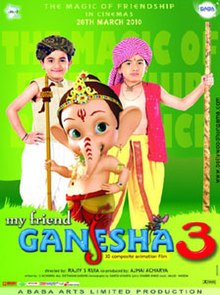
MY FRIEND GANESHA 3 (2010)
Summary:
My Friend Ganesha 3 continues the heartwarming and inspiring tradition of its predecessors, introducing a new young protagonist, Rohan, who finds solace and guidance in the divine friendship of Lord Ganesha. Set against the backdrop of a bustling modern city, the film explores themes of environmental conservation, community spirit, and the importance of preserving heritage. Rohan, a shy and introverted boy struggling to adapt to a new school and city, discovers a dilapidated ancient Ganesha temple slated for demolition by a powerful real estate developer. Feeling a deep connection to the deity, Rohan embarks on a courageous mission to save the temple and the surrounding public park, guided by the wisdom and subtle magical interventions of his divine friend.
The movie beautifully portrays Rohan's journey from a lonely outsider to a confident leader, as he rallies his new friends and the local community against formidable odds. Ganesha, visible only to Rohan, acts as a benevolent mentor, helping him overcome fear, find his voice, and understand the true meaning of faith, friendship, and collective action. My Friend Ganesha 3 is an enchanting blend of fantasy, social commentary, and family drama, delivering a powerful message about standing up for what is right and the enduring power of belief in oneself and in a higher purpose.
Keywords: My Friend Ganesha 3, 2010, Rohan, Ganesha, Family Film, Children's Film, Fantasy, Social Drama, Environmentalism, Heritage, Community.
Plot:
Rohan, a sensitive and artistic ten-year-old boy, finds himself adrift after his family relocates to a sprawling, impersonal metropolis. His parents, both highly ambitious professionals, are often preoccupied with their careers, leaving Rohan feeling overlooked and isolated. He struggles to make friends at his new school, where his quiet nature makes him an easy target for a group of boisterous bullies. Seeking refuge from the concrete jungle and his own loneliness, Rohan often wanders into a forgotten corner of the city, discovering a small, overgrown public park. Tucked away within this park is an ancient, crumbling Ganesha temple, its vibrant colours faded, its carvings worn by time, yet radiating an undeniable aura of peace and history. Rohan feels an immediate, inexplicable connection to the deity within.
One afternoon, while sketching the temple, Rohan pours out his heart to the Ganesha idol, confiding his fears, his loneliness, and his desire for a true friend. To his astonishment, a gentle, resonant voice responds, offering words of comfort and wisdom. Rohan looks around, bewildered, only to find himself alone. Over the next few days, the voice returns, and soon, Lord Ganesha himself materializes before Rohan, a benevolent, majestic figure visible only to the boy. Ganesha, with his characteristic warmth and wit, becomes Rohan's secret companion and guide, encouraging him to be brave, to speak his mind, and to look for the good in people and situations. He reminds Rohan that true strength comes from within and that even the smallest voice can make a big difference.
Rohan's newfound solace is short-lived. He overhears hushed conversations among park regulars and sees ominous notices posted. A powerful real estate magnate, Mr. Khanna, known for his ruthless business tactics, has acquired the rights to demolish the entire park and the temple to construct a luxurious shopping mall and residential complex. The news sends a shockwave through the local community, dividing residents between those tempted by the promise of development and jobs, and those heartbroken by the impending loss of their beloved green space and sacred site. Rohan is devastated; the temple has become his sanctuary, and Ganesha, his only friend in this new city. Ganesha, however, assures Rohan that all is not lost and that he has the power to change things, urging him to gather courage and fight for what he believes in.
Inspired by Ganesha's wisdom, Rohan decides he must act. His first step is to connect with other children who frequent the park. He befriends Priya, a spirited and articulate girl who is fiercely protective of nature, and Sameer, a tech-savvy boy who can navigate the digital world with ease. Initially, they are skeptical of Rohan's claims about a talking Ganesha, but they are moved by his passion for the temple and the park. Together, the trio forms an unlikely alliance, determined to save their cherished space. Ganesha subtly aids them, often leading Rohan to crucial information or inspiring ideas, like drawing Rohan's attention to an old, forgotten plaque detailing the temple's historical significance, which he then shares with Priya and Sameer.
Their mission is fraught with challenges. Mr. Khanna's legal team and public relations machinery are formidable. They spread misinformation, promising a modern, green development that would benefit everyone, while quietly pressuring local officials. Rohan and his friends face ridicule from Khanna's supporters and even threats from his henchmen who try to scare them away from the park. Rohan's parents, engrossed in their work, initially dismiss his concerns as childish fantasies, urging him to focus on his studies rather than "wasting time" on a lost cause. This lack of parental support adds another layer of emotional struggle for Rohan, but Ganesha reminds him that true conviction often stands alone, and that his parents, though busy, love him and will eventually understand.
The children begin their grassroots campaign. Priya, with her persuasive speaking skills, starts talking to local shopkeepers and residents, explaining the environmental impact and cultural loss. Sameer creates an online petition and a social media campaign, sharing photos and videos of the park's beauty and the temple's historical value, rapidly gaining traction. Rohan, utilizing his artistic talent, draws poignant sketches of the temple and the park's wildlife, creating posters that resonate deeply with the community's emotional attachment to the place. Ganesha's guidance is invaluable; when the children struggle to find historical documents proving the temple's protected status, Ganesha leads Rohan to an old, dusty municipal archive, where Rohan discovers a forgotten gazette notification declaring the temple and a portion of the park as a heritage site, making its demolition illegal.
Armed with this crucial evidence, the children approach a sympathetic local journalist, Ms. Sharma, who investigates their claims and publishes a series of articles exposing Mr. Khanna's deceptive practices and the true historical significance of the temple. Public opinion begins to turn against Khanna. The local authorities, initially swayed by Khanna's influence, are now forced to acknowledge the mounting public pressure and the legal implications of the heritage status. Mr. Khanna, however, is not one to give up easily. He accelerates his demolition plans, securing a last-minute, dubious permit, intending to raze the temple before any further legal challenges can be mounted. A final public hearing is scheduled, meant to be a mere formality before the bulldozers move in.
The day of the hearing arrives, tense and charged. Mr. Khanna presents a polished, confident case, reiterating his promises of economic prosperity and dismissing the temple as an old, unsafe structure. Rohan, Priya, and Sameer are given a chance to speak. Priya articulates the environmental and social impact, while Sameer presents the overwhelming online support. But it is Rohan, the once-shy boy, who delivers the most powerful speech. With Ganesha's encouraging presence beside him, invisible to all others, Rohan speaks from the heart about the soul of the community, the importance of preserving history for future generations, and the irreplaceable value of nature over material gain. He dramatically presents the rediscovered heritage notification, a document that invalidates Khanna's permit.
The revelation sends shockwaves through the courtroom. The community members, now fully aware of the deception, erupt in applause and support for Rohan and his friends. The authorities, left with no choice, are forced to halt the demolition order and launch a full investigation into Mr. Khanna's dealings. In the aftermath, Mr. Khanna's plans are thoroughly derailed, and the temple and park are officially declared protected heritage sites, ensuring their preservation for generations to come. Rohan’s parents, having witnessed their son's bravery and the positive impact he made, are filled with immense pride and finally understand the depth of his convictions. They promise to be more present in his life, strengthening their family bond. The temple is lovingly restored by the community, becoming a vibrant hub once more. Rohan, no longer lonely or shy, has found his voice, forged true friendships, and learned that with faith, courage, and a little divine help, even a small boy can move mountains. Ganesha, his mission accomplished, offers a final, knowing smile before fading from Rohan's sight, leaving behind a legacy of wisdom and courage in the young boy's heart.
Cast (Lead Roles):
- Master Krrish as Rohan
- Anup Soni as Mr. Khanna
- Ahsaas Channa as Priya
- Rushiraj Pawar as Sameer
- Ashish Vidyarthi as Rohan's Father
- Divya Dutta as Rohan's Mother
- Juhi Chawla as Ms. Sharma (Journalist)
- Voice of Ganesh: Sachin Khedekar
Crew:
- Director: Rajiv S. Ruia
- Writer: Rajiv S. Ruia
- Producer: M. R. Shah, Rajiv S. Ruia
- Music Director: Sameer Phaterpekar
- Cinematography: Inderjit Bansal
- Editor: Sanjay Sankla
Release Info:
- Original Release Date: October 22, 2010
- Language: Hindi
- Genre: Animation, Children's Film, Fantasy, Family, Social Drama
- Running Time: 105 minutes
- Accolades: Nominated for Best Children's Film at various regional awards.