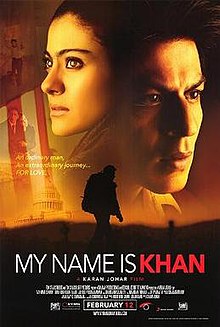



Discription
MY NAME IS KHAN (2010)
Summary:
My Name Is Khan is a powerful romantic drama that explores themes of love, prejudice, and the indomitable human spirit in the aftermath of the 9/11 terrorist attacks. The film centers on Rizwan Khan, a Muslim man with Asperger's Syndrome, who falls in love with and marries Mandira, a Hindu single mother living in San Francisco. Their idyllic life is shattered by a tragic event fueled by post-9/11 Islamophobia, leading Mandira to a desperate plea that sends Rizwan on an extraordinary cross-country journey.
Rizwan's quest is to meet the President of the United States and deliver a simple but profound message: "My name is Khan, and I am not a terrorist." His journey is fraught with challenges, misunderstandings, and acts of both cruelty and profound kindness, ultimately becoming a testament to his innocence, resilience, and unwavering love for Mandira. The film critically examines societal biases, the impact of terrorism on ordinary lives, and the enduring power of empathy and humanity.
Keywords: My Name Is Khan, 2010, Shah Rukh Khan, Kajol, Drama, Romance, Asperger's Syndrome, Terrorism, America, Journey.
Plot:
The story begins with Rizwan Khan, a young Indian Muslim boy growing up in Borivali, Mumbai. He is depicted as different from other children, exhibiting unusual behaviors and a remarkable memory. His mother, Razia, recognizes his unique needs and teaches him to cope with his condition, which is later identified as Asperger's Syndrome. She instills in him a fundamental principle: there are only two kinds of people in the world – good people who do good things and bad people who do bad things, irrespective of their religion or background. After his mother's death, Rizwan moves to San Francisco, USA, to live with his younger brother Zakir and Zakir's wife, Haseena. Zakir, a successful businessman, helps Rizwan find work as a door-to-door salesman for a cosmetic company.
During a sales call, Rizwan encounters Mandira, a vibrant Hindu single mother who owns a hair salon. Despite his social awkwardness and unusual mannerisms, Rizwan is instantly smitten by Mandira's beauty and spirit. Mandira, initially amused and then intrigued by his sincerity, gradually warms to him. Their unconventional courtship blossoms, and despite Zakir's initial objections – fearing Rizwan's condition would make him a burden and that Mandira, a Hindu, was not a suitable match – Rizwan and Mandira marry. Mandira's young son, Sameer (Sam), develops a strong bond with Rizwan, who becomes a loving stepfather. They establish a happy life together in America, opening a small business and enjoying their unconventional family dynamic.
However, their peaceful existence is shattered by the September 11, 2001, terrorist attacks. The aftermath of 9/11 brings a wave of anti-Muslim sentiment and Islamophobia across the United States. Rizwan, Mandira, and Sam begin to experience subtle and overt discrimination. Sam, in particular, becomes a target of bullying at school due to his Muslim surname, Khan, despite being Hindu. One fateful day, Sam is severely beaten by older boys, leading to his death. The tragedy devastates Mandira, who, in her grief and anger, blames Rizwan and his Muslim identity for their son's death. She bitterly tells him that Sam died because his surname was Khan. In her profound anguish, she demands that Rizwan leave her and only return when he can tell the President of the United States that "My name is Khan, and I am not a terrorist."
Taking Mandira's words literally, Rizwan embarks on an arduous cross-country journey to meet the President. His journey is marked by his unique way of perceiving the world, his struggles with social interaction, and his unwavering determination. He travels by bus, car, and on foot, often relying on the kindness of strangers. Along the way, he encounters a diverse range of Americans, some prejudiced, others compassionate. He stays in small motels, works odd jobs, and diligently records his experiences. He befriends a sympathetic professor, Radha, who recognizes his condition and helps him understand the complexities of the world. Rizwan also finds himself in the small, struggling town of Wilhelmina, Georgia, which is devastated by a hurricane. He uses his practical skills and unwavering dedication to help the community, organizing relief efforts and becoming a local hero, garnering media attention for his selfless acts.
Rizwan's attempts to meet the President are repeatedly thwarted. His unusual behavior and the fact that he is a Muslim man traveling across the country with a specific, seemingly strange mission attract the attention of law enforcement. He is eventually arrested at an airport while attempting to deliver his message, mistaken for a terrorist due to his suspicious behavior and a past incident where he fixed a broken clock at a mosque that was under surveillance. He undergoes intense interrogation by the FBI, who initially believe he is part of a sleeper cell. During his detention, his story begins to leak to the media, amplified by Radha and other sympathetic individuals. His innocence and the true nature of his journey slowly come to light, sparking public interest and debate about prejudice and perception.
Meanwhile, Mandira, still grappling with her grief, slowly begins to process her anger and realize the injustice of her words to Rizwan. She sees news reports of Rizwan's journey and his humanitarian efforts in Wilhelmina. She is deeply moved and filled with regret, understanding that her blame was misplaced. She starts her own journey, retracing Rizwan's steps, trying to find him and clear his name. She works with journalists and human rights activists to bring attention to Rizwan's plight and the broader issue of Islamophobia. Her efforts, combined with the growing public sympathy for Rizwan, put pressure on the authorities.
Eventually, Rizwan is released from custody. His story has become a national phenomenon. He finally gets his opportunity to meet the newly elected President of the United States. In a poignant and emotionally charged scene, Rizwan stands before the President and delivers his simple, heartfelt message: "My name is Khan, and I am not a terrorist." The President, deeply moved by Rizwan's journey and his pure intentions, acknowledges his message and embraces him, symbolizing a message of acceptance and understanding. Mandira, witnessing this moment, rushes to Rizwan, and they are finally reunited, their love reaffirmed and their wounds beginning to heal. The film concludes with Rizwan and Mandira looking towards a future where love and empathy can overcome prejudice, leaving the audience with a powerful message of hope and the importance of looking beyond superficial differences.
Cast (Lead Roles):
- Shah Rukh Khan as Rizwan Khan
- Kajol as Mandira Khan
- Jimmy Shergill as Zakir Khan
- Sonya Jehan as Haseena Khan
- Arjun Mathur as Sameer (Sam)
Crew:
- Director: Karan Johar
- Producers: Hiroo Yash Johar, Gauri Khan
- Screenplay: Shibani Bathija
- Dialogue: Niranjan Iyengar
- Music Director: Shankar-Ehsaan-Loy
- Cinematography: Ravi K. Chandran
- Editor: Deepa Bhatia
Release Info:
- Original Release Date: February 12, 2010
- Language: Hindi, English
- Genre: Drama, Romance
- Running Time: 165 minutes
- Accolades: Filmfare Award for Best Actor (Shah Rukh Khan), Filmfare Award for Best Actress (Kajol), Filmfare Award for Best Director (Karan Johar), IIFA Award for Best Actor (Shah Rukh Khan), IIFA Award for Best Actress (Kajol), IIFA Award for Best Director (Karan Johar).