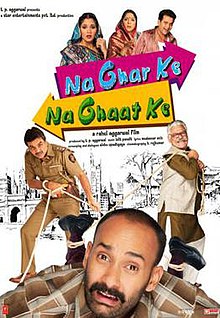



Discription
NA GHAR KE NA GHAAT KE (2010)
Summary:
Na Ghar Ke Na Ghaat Ke is a poignant yet humorous Hindi comedy-drama that chronicles the journey of Sankata Prasad Tripathi, a simple, good-hearted man from the quiet village of Bhojpur. Driven by aspirations of a better life and the desire to prove himself, Sankata ventures into the bustling, unforgiving metropolis of Mumbai. His arrival in the city is marked by an immediate culture shock, as his naive charm and traditional values clash dramatically with the fast-paced, pragmatic, and often cutthroat urban environment.
The film delves into Sankata's myriad struggles as he attempts to establish himself, from failed business ventures to navigating the complex web of city bureaucracy and human interactions. Guided, and sometimes misguided, by his cynical but well-meaning uncle, Hanuman Prasad Tripathi, and finding an unexpected connection with the independent Sheela, Sankata's journey is a humorous exploration of identity, belonging, and the search for one's place in a world that constantly tests personal values. It's a tale of a man who feels "neither here nor there," ultimately discovering that home is not just a physical location, but a state of mind achieved through self-acceptance and resilience.
Keywords: Na Ghar Ke Na Ghaat Ke, 2010, Rahul Aggarwal, Paresh Rawal, Narayani Shastri, Comedy, Drama, Mumbai, Village Life, Culture Shock.
Plot:
The narrative of "Na Ghar Ke Na Ghaat Ke" opens in the idyllic, slow-paced village of Bhojpur, where Sankata Prasad Tripathi (played by Rahul Aggarwal) leads a life steeped in tradition and simplicity. Sankata is a man of unwavering honesty and a gentle disposition, qualities that are highly valued in his rural community. However, beneath his unassuming exterior lies a simmering ambition and a desire to make something more of his life. Encouraged by his family, particularly his mother (Neena Gupta), who harbors dreams of her son achieving success, Sankata decides to leave the familiar comfort of Bhojpur and embark on a journey to Mumbai, the city of dreams, hoping to carve out a prosperous future for himself and his family. He carries with him not just a small bag of belongings, but also a heart full of hope and an unshakeable belief in the power of hard work and good intentions.
Upon his arrival in Mumbai, Sankata is immediately overwhelmed by the sheer scale and cacophony of the city. The noise, the crowds, the relentless pace, and the stark contrast to his peaceful village life hit him like a tidal wave. He seeks out his maternal uncle, Hanuman Prasad Tripathi (Paresh Rawal), a long-time resident of Mumbai who, despite his years in the city, remains a perpetually struggling and somewhat cynical individual. Hanuman Mama, with his street-smart wisdom tempered by his own series of failures, serves as Sankata's reluctant guide. He offers Sankata a roof over his head and a steady stream of cautionary tales about the city's deceptive nature, warning him against its pitfalls and the many ways it can exploit the innocent. Sankata, however, remains largely undeterred, his optimism a shield against his uncle's pragmatism.
Sankata's initial attempts to find work or start a business are met with a series of comical and disheartening setbacks. He first tries to leverage his village heritage by selling traditional 'churan' (digestive powder), believing in its inherent goodness and medicinal properties. His earnest sales pitches, however, fall flat against the aggressive hawking techniques of seasoned city vendors, and he quickly realizes that sincerity alone is not enough to thrive in this competitive environment. He faces ridicule, rejection, and even minor exploitation, as he struggles to understand the unwritten rules of urban commerce. Each failed venture chips away a little at his confidence, but his inherent resilience keeps him pushing forward.
Amidst his struggles, Sankata encounters Sheela (Narayani Shastri), a spirited and independent young woman who works diligently to support herself. Sheela embodies the pragmatic, self-reliant spirit of Mumbai, a stark contrast to Sankata's more traditional upbringing. Their initial interactions are marked by a clash of personalities and perspectives – Sheela finds Sankata's naivety amusing yet frustrating, while Sankata is both intrigued and slightly intimidated by her modern outlook. Despite their differences, a gradual attraction begins to blossom between them, with Sheela slowly recognizing Sankata's genuine goodness beneath his awkward exterior, and Sankata finding a grounding presence in Sheela's practical wisdom.
With Hanuman Mama's help, Sankata manages to secure a small, dilapidated shop space. He tries his hand at various retail ventures, from selling general provisions to attempting to market peculiar gadgets, often with disastrous results. His lack of business acumen and his trusting nature make him an easy target for opportunistic individuals. He unknowingly gets entangled in petty schemes, becoming an unwitting pawn in the smaller machinations of city life. His encounters with local bureaucracy and minor criminal elements are a constant source of frustration and humor. He faces demands for bribes from corrupt officials and intimidation from local goons, such as Bhairon Singh (Ravi Kishan), a seemingly menacing local strongman who, like many characters in Mumbai, turns out to have more layers than initially perceived, sometimes showing a surprising, albeit self-serving, streak of humanity.
A significant turning point occurs when Sankata encounters a philosophical street vendor (Sunil Shetty, in a cameo), who, through a seemingly casual conversation, imparts a crucial piece of advice: that survival in the city isn't about changing who you are, but about adapting your methods while staying true to your core. This encounter resonates deeply with Sankata, who has been grappling with an internal conflict. He begins to question whether his pursuit of success in Mumbai is worth sacrificing his values and identity. He feels increasingly disconnected, like the title suggests, "Na Ghar Ke Na Ghaat Ke" – neither truly belonging to the simplicity of his village life nor fully integrated into the complexities of the city. He misses the clear moral compass of Bhojpur, finding the moral ambiguity of Mumbai profoundly unsettling.
The climax of the film revolves around a major threat to Sankata's small shop, possibly due to a property dispute or a larger extortion scheme orchestrated by Bhairon Singh. This crisis forces Sankata to confront his dilemma head-on. He must decide whether to give up, return to his village defeated, or fight for his place in Mumbai while upholding his integrity. This time, however, he doesn't face it alone. Sheela, recognizing his inherent goodness and resilience, stands by him, offering practical support and emotional strength. Even Hanuman Mama, shedding some of his cynicism, steps up to assist, using his limited street knowledge to navigate the situation.
In a climactic confrontation, Sankata, drawing upon his innate honesty and a newfound sense of self-assurance, manages to resolve the crisis, not through brute force or cunning, but through a unique blend of his unwavering principles and a pragmatic understanding of the city's ways. He doesn't necessarily achieve grand financial success or become a powerful figure, but he carves out a niche for himself. The film concludes with Sankata finding a peaceful resolution to his internal struggle. He learns that "home" is not just a geographical location but a state of mind, and that identity is fluid, allowing one to integrate new experiences without losing one's essence. He accepts that he may always be "Na Ghar Ke Na Ghaat Ke" in the conventional sense, but he has found his own unique ground, a place where his village values can coexist with his urban reality. His relationship with Sheela solidifies, symbolizing his acceptance of a new kind of belonging and the promise of a future built on mutual respect and understanding. The film ends on a note of quiet triumph and self-acceptance, emphasizing that true success lies in finding peace and purpose within oneself, regardless of external circumstances.
Cast (Lead Roles):
- Rahul Aggarwal as Sankata Prasad Tripathi
- Paresh Rawal as Hanuman Prasad Tripathi (Mama)
- Narayani Shastri as Sheela
- Sunil Shetty as Philosophical Street Vendor (Guest Appearance)
- Ravi Kishan as Bhairon Singh
- Neena Gupta as Mrs. Tripathi (Sankata's Mother)
Crew:
- Director: Rahul Aggarwal
- Writer: Rahul Aggarwal
- Producer: Rahul Aggarwal
- Music (Songs): Shankar-Ehsaan-Loy
- Music (Background Score): Sanjoy Chowdhury
- Cinematography: S. Krishna
- Editor: Ritesh Soni
Release Info:
- Original Release Date: 12 March 2010
- Language: Hindi
- Genre: Comedy, Drama
- Running Time: 128 minutes
- Accolades: None significant