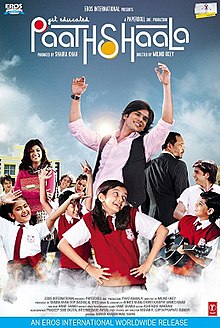


Discription
PAATHSHAALA (2010)
Summary:
Paathshaala is a poignant Hindi drama that delves into the pressing issues plaguing the Indian education system, primarily focusing on the commercialization and undue pressure placed upon students. The film centers around a school where a new management brings in a wave of changes, ostensibly for the betterment of the institution, but which ultimately lead to increased stress, competition, and a loss of innocence for the children. It explores the delicate balance between academic excellence and the holistic development of a child, highlighting how profit-driven motives can corrupt the very essence of learning.
Through the eyes of a new English teacher, Rahul Prakash Udyavar, and the struggles of the students and dedicated teachers, the narrative exposes the detrimental effects of excessive academic burden, expensive extra-curricular activities, and the erosion of genuine teacher-student relationships. The film culminates in a powerful student protest, advocating for a more humane and child-centric approach to education, challenging the prevailing notion that success is solely measured by grades and material achievements. It serves as a social commentary, urging parents, educators, and institutions to re-evaluate their priorities in shaping the future of the younger generation.
Keywords: Paathshaala, 2010, Shahid Kapoor, Nana Patekar, Education System, Drama, Social Commentary.
Plot:
The film "Paathshaala" opens by introducing Rahul Prakash Udyavar, a young, optimistic, and unconventional English teacher who joins Saraswati Vidya Mandir school. Initially, the school appears to be a vibrant and happy place, filled with enthusiastic students and dedicated teachers like Indu Ma'am, the geography teacher, and the well-respected principal, Mr. Sharma. Rahul quickly endears himself to the students with his refreshing teaching methods, which emphasize understanding and joy over rote learning and excessive pressure. He encourages creativity, critical thinking, and a love for learning, fostering a strong bond with his students, particularly a bright and sensitive boy named Shantanu Moitra.
However, the idyllic atmosphere of Saraswati Vidya Mandir soon begins to change drastically with the arrival of the school's new manager, Mr. Sharma, who is also the principal, and his team. Mr. Sharma, driven by a vision of making the school "the best" and financially self-sufficient, introduces a series of radical and commercially-oriented reforms. These changes include implementing expensive extra classes for all subjects, making mandatory excursions and workshops that come with hefty fees, frequent changes in school uniforms, and a relentless focus on achieving perfect scores in examinations. The underlying motive behind these reforms is profit, as the school management aims to attract affluent parents and boost its public image, often at the expense of the students' well-being and the teachers' autonomy.
As these new policies take effect, the once cheerful students begin to buckle under immense pressure. Their schedules become packed with academic and extra-curricular activities, leaving little time for play, rest, or personal development. The joy of learning is replaced by the fear of failure, competition, and the constant need to meet unrealistic expectations. Shantanu, a talented and sensitive child, starts to struggle with the increasing academic burden, leading to anxiety and a decline in his overall happiness. Other students also face similar dilemmas; one student's parents push him relentlessly for perfect grades, another is forced to participate in an expensive fashion show despite her disinterest, and many are simply overwhelmed by the constant stress to perform.
The teachers, including Indu Ma'am and the music teacher, are also caught in a difficult position. While they initially try to resist the changes and advocate for the students, they are slowly coerced into compliance by the management's threats of salary cuts or even termination. They witness the transformation of their beloved school into a high-pressure factory, where children are treated as products rather than individuals. Rahul, being new, observes these changes with growing concern and tries to intervene subtly, using his influence with the students to empower them to think for themselves and voice their feelings. He notices the visible signs of distress among the children, from sleepless nights and loss of appetite to emotional breakdowns.
The situation escalates dramatically when a student, unable to cope with the pressure of an upcoming exam and the fear of disappointing his parents, attempts suicide. This incident sends shockwaves through the school community and serves as a stark wake-up call. Rahul realizes that passive resistance is no longer enough. He decides to take a more proactive approach, encouraging the students to understand their rights and the importance of speaking up against injustice. He uses his teaching methods to subtly educate them about the power of collective action and peaceful protest.
Inspired by Rahul's guidance, Shantanu and his friends, along with other students, decide to organize a peaceful protest to highlight the issues they are facing. They create placards, write petitions, and plan to stage a walkout. The teachers, initially hesitant, are moved by the students' courage and, after much deliberation, decide to support them, understanding that the children's future and well-being are paramount. The protest gains momentum, attracting the attention of parents, the media, and the wider public. The media coverage brings the school's practices into the spotlight, exposing the commercialization and the detrimental impact on the students.
Mr. Sharma and the school management initially try to suppress the protest and discredit the students and teachers. However, the overwhelming public support and the undeniable evidence of the children's suffering make it difficult for them to maintain their stance. The media scrutiny forces a re-evaluation of the school's policies. During the climax, Rahul delivers a powerful speech, emphasizing that education should be about nurturing young minds, fostering creativity, and building character, not just about grades or financial gain. He argues for a system that values happiness, empathy, and holistic development over ruthless competition and material success.
The film concludes with a significant shift in the school's approach. The management is forced to roll back many of its commercial policies, and the focus returns to a more child-centric and humane education system. The students regain their lost joy and freedom, and the teachers are empowered to teach with passion and conviction. Rahul, having fulfilled his purpose of igniting change and empowering the students, decides to move on, leaving behind a legacy of awakened minds and a school that has learned a valuable lesson about the true meaning of education. His departure is bittersweet, as the students are sad to see him go but are forever grateful for his transformative influence.
Cast (Lead Roles):
- Shahid Kapoor as Rahul Prakash Udyavar
- Ayesha Takia Azmi as Indu Ma'am
- Nana Patekar as Principal Aditya Sharma
- Sushant Singh as Karan
- Saurabh Shukla as Music Teacher
- Swini Khara as Swini
- Dwij Yadav as Shantanu Moitra
- Avika Gor as Avika
- Ali Haji as Ali
- Shah Rukh Khan as Special Appearance (Narrator and in song "Aye Khuda")
Crew:
- Director: Milind Ukey
- Producer: Ahmed Khan
- Story: Ahmed Khan
- Screenplay & Dialogue: Milind Ukey
- Music Director: Hanif Shaikh, Monty Sharma, Sajid-Wajid
- Cinematography: S. S. Mahendra
- Editor: Sanjay Sankla
- Choreography: Ahmed Khan
Release Info:
- Original Release Date: April 16, 2010
- Language: Hindi
- Genre: Drama, Social
- Running Time: 140 minutes
- Accolades: None listed