


Discription
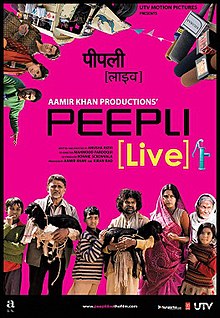
PEEPLI LIVE (2010)
Summary:
Peepli Live is a biting Indian satirical comedy-drama film that exposes the farcical reality of media sensationalism, political opportunism, and rural distress in contemporary India. Set in the impoverished village of Peepli, the film centers on Natha, a poor farmer teetering on the brink of losing his land due to an unpaid loan. A seemingly offhand suggestion by his elder brother, Budhia, to commit suicide in order to avail government compensation for farmer suicides, sparks an unexpected media frenzy that transforms their quiet village into a chaotic spectacle.
The film brilliantly critiques the exploitative nature of television news, where human tragedy becomes a commodity for ratings, and politicians scramble to score points rather than address systemic issues. As Natha's impending suicide becomes a national event, the film masterfully portrays the absurd lengths to which various stakeholders go, from rival news channels vying for exclusive coverage to local authorities attempting to control the narrative. Through its darkly humorous lens, Peepli Live sheds light on the plight of marginalized farmers and the often-indifferent systems meant to support them, leaving a lasting impression on its audience about the true cost of poverty and the spectacle of suffering.
Keywords: Peepli Live, 2010, Omkar Das Manikpuri, Raghubir Yadav, Satire, Rural India, Farmer Suicide, Media, Politics, Drama.
Plot:
The story of Peepli Live unfolds in the drought-ridden, impoverished village of Peepli in rural India, a setting that immediately establishes the socio-economic backdrop of the narrative. We are introduced to Natha (Omkar Das Manikpuri) and Budhia (Raghubir Yadav), two brothers who are poor farmers struggling to make ends meet. Their land is on the verge of being repossessed by the bank due to an outstanding loan they are unable to repay. The desperation of their situation is palpable, as they face not just financial ruin but the complete loss of their livelihood and dignity. During a particularly heated argument about their bleak future, Budhia, in a fit of frustration and dark humor, suggests to Natha that he should commit suicide. This isn't a genuine suggestion born out of malice, but rather a cynical remark about the government's policy of offering compensation to the families of farmers who take their own lives. The compensation, though meager, is substantial enough to clear their debt and provide a small sum for the family's survival, a grim incentive in a system that often fails to provide adequate support for living farmers.
Natha, overwhelmed by his circumstances and seeing no other viable option, considers Budhia's morbid suggestion. This seemingly private conversation, however, is overheard by a local journalist, Rakesh (Nawazuddin Siddiqui), who is always on the lookout for a sensational story to impress his boss, the head of the national news channel, Kumar Deepak (Vishal Sharma). Rakesh, sensing a potential scoop, reports Natha's intention. What begins as a local news item quickly escalates into a national phenomenon. The story of "Natha's impending suicide" captures the imagination of the media, transforming the quiet village of Peepli into a bustling, chaotic media circus. Television crews from various national channels descend upon the village, each vying for exclusive access and the most dramatic footage. Nandita Malik (Malaika Shenoy), a glamorous and ambitious anchor from a leading news channel, becomes the face of the story, turning Natha's personal tragedy into a daily prime-time spectacle.
The media's arrival brings with it an unprecedented level of attention and scrutiny to Peepli. Natha, initially a reluctant participant in this unfolding drama, finds himself thrust into the national spotlight. His every move is monitored, his every word analyzed, and his family's grief becomes public property. The villagers, initially bewildered by the sudden influx of cameras and reporters, soon adapt, some even trying to capitalize on the situation. Local vendors set up stalls, selling food and souvenirs to the media personnel, and the village itself becomes a strange, temporary tourist attraction centered around the anticipated tragedy. The absurdity of the situation is highlighted by the contrast between the genuine suffering of Natha and his family and the detached, often exploitative, pursuit of ratings by the media. The news channels engage in a cutthroat competition, fabricating angles, exaggerating details, and creating a narrative that serves their commercial interests rather than accurately portraying Natha's plight.
The political establishment is quick to react to the media frenzy. The Chief Minister (Naseeruddin Shah), portrayed as a bumbling and opportunistic leader, sees Natha's case as both a potential PR disaster and an opportunity to score political points. His advisors and party members scramble to manage the crisis, fearing that a farmer's suicide on national television could damage their image. They devise various schemes to either prevent Natha's suicide or, failing that, to control the narrative surrounding it. The opposition party, led by a shrewd and cynical leader, naturally seizes upon the situation to criticize the government's agricultural policies and its perceived indifference to farmer suicides. They visit Natha, offering condolences and thinly veiled political promises, all while ensuring their presence is captured by the ever-present cameras. The plight of the farmer, which should be a serious policy issue, is reduced to a political football, tossed back and forth between rival parties more concerned with electoral gains than genuine solutions.
Amidst this escalating chaos, Natha's personal suffering is largely ignored. He is no longer just a farmer facing destitution; he is a symbol, a commodity, a pawn in a larger game played by the media and politicians. His wife, Dhaniya (Shalini Vatsa), and his ailing mother, Amma (Farrukh Jaffar), struggle to cope with the invasion of their privacy and the immense pressure. Amma, in particular, delivers some of the film's most poignant moments, her simple wisdom cutting through the manufactured drama. The villagers, too, are drawn into the spectacle, some offering Natha advice, others simply observing with a mix of curiosity and resentment. Local goons and opportunists also emerge, attempting to manipulate the situation for their own benefit, adding another layer of cynicism to the already complex scenario.
As the date of the "scheduled" suicide draws closer (a date largely fabricated and propagated by the media), the tension mounts. Natha, overwhelmed by the constant attention, the conflicting advice, and the sheer absurdity of his situation, begins to crack under pressure. He becomes increasingly withdrawn, a silent observer of his own impending doom, which has now become a national countdown. The media, desperate for a climax, egg on the situation, creating a morbid expectation among the public. The government, in a desperate attempt to prevent the suicide, offers Natha a meager sum and a house, but this gesture is seen as too little, too late, and largely performative. The film highlights the irony that while Natha's death is being anticipated with bated breath, his life, and the lives of countless other farmers, were largely ignored until the prospect of a sensational story arose.
In a crucial turn of events, just as the media circus reaches its peak, Natha mysteriously disappears. This unexpected development throws everyone into a frenzy. The news channels, deprived of their anticipated climax, scramble to find a new angle. Some speculate that he has indeed committed suicide, his body hidden, while others suggest he might have been kidnapped or run away. The search for Natha becomes the new national obsession, and the media, ever adaptable, pivots its coverage to the "missing farmer" story. The government launches a search operation, more for public relations than genuine concern, while the opposition continues to blame the ruling party for Natha's disappearance. The villagers, too, are divided, some genuinely worried, others cynical about the entire affair.
The film reaches its satirical peak during the search for Natha. The media's frantic efforts to locate him lead to various comical and poignant misadventures. In a darkly humorous sequence, Natha's family, in their desperation, performs his last rites, believing him to be dead, only for the truth to be revealed later. The resolution, when it finally comes, is both anticlimactic and deeply profound. It is revealed that Natha did not commit suicide or disappear under dramatic circumstances. Instead, in a moment of sheer exhaustion and desire for normalcy, he simply walked away from the media circus. He is eventually found working as a daily wage laborer in a construction site in a nearby city, having shed his identity as "the farmer who was going to commit suicide" to become just another anonymous worker struggling for survival. His "disappearance" and the subsequent media frenzy only served to underscore the pointlessness and superficiality of the entire spectacle.
The film concludes by showing that life in Peepli eventually returns to its mundane rhythm, though perhaps with a lingering cynicism. The media moves on to its next big story, the politicians to their next election campaign. Natha's story, once a national sensation, fades from public memory. The government's policies regarding farmer suicides remain largely unchanged, and the systemic issues that drove Natha to contemplate suicide persist. Peepli Live masterfully uses dark humor and satire to expose the hypocrisy and detachment of modern society, where human suffering is often commodified and consumed as entertainment, while the root causes of that suffering remain unaddressed. It leaves the audience with a stark reminder of the harsh realities faced by India's rural poor and the often-absurd world created by a sensationalist media and self-serving political class.
Cast (Lead Roles):
- Omkar Das Manikpuri as Natha
- Raghubir Yadav as Budhia
- Shalini Vatsa as Dhaniya
- Farrukh Jaffar as Amma
- Malaika Shenoy as Nandita Malik
- Nawazuddin Siddiqui as Rakesh
- Divya Jagdale as Chief Minister's Secretary
- Vishal Sharma as Kumar Deepak
- Sitaram Panchal as Bhai Thakur
- Naseeruddin Shah as Chief Minister
Crew:
- Director: Anusha Rizvi
- Writer: Anusha Rizvi
- Producers: Aamir Khan, Kiran Rao
- Music: Indian Ocean, Ram Sampath
- Cinematography: Mahmood Saifi
- Editor: Hemanti Sarkar
- Production Company: Aamir Khan Productions
Release Info:
- Original Release Date: August 13, 2010
- Language: Hindi
- Genre: Satire, Drama, Comedy
- Running Time: 106 minutes
- Accolades: Official Selection at the Sundance Film Festival (2010), Best Film (Audience Choice) at the 14th Shanghai International Film Festival, nominated for Best Feature Film at the Asia Pacific Screen Awards.