

Discription
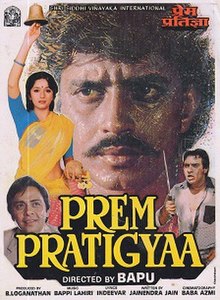
PREM PRATIGYAA (1989)
Summary:
Prem Pratigyaa is a compelling 1989 Hindi romantic action-drama film that weaves a tale of love, revenge, and justice against the backdrop of rural oppression. The story introduces Raja, a tough yet golden-hearted orphan who arrives in a village plagued by the tyrannical rule of the ruthless Thakur and his equally villainous son, Bheema. Here, he encounters Laxmi, a spirited young woman whose family, like many others, suffers under the Thakur's iron fist. Initially clashing, Raja and Laxmi soon find their animosity transforming into deep affection, forming the emotional core of the narrative.
As Raja witnesses the escalating atrocities committed by the Thakur and his goons, particularly the tragic loss suffered by Laxmi's family, he takes a solemn vow – a 'pratigyaa' – to avenge the wrongs, protect the innocent, and liberate the village from its oppressors. The film brilliantly blends intense action sequences with heartfelt romance, showcasing Mithun Chakraborty's powerful performance as the avenging hero and Madhuri Dixit's captivating portrayal of the resilient heroine. It's a classic Bollywood saga of good triumphing over evil, fueled by an unbreakable promise and an enduring love.
Keywords: Prem Pratigyaa, 1989, Mithun Chakraborty, Madhuri Dixit, Romantic Drama, Action, Revenge, Justice.
Plot:
The story of Prem Pratigyaa unfolds in a remote, picturesque village, yet one that lives under the dark shadow of oppression. We are introduced to Raja (Mithun Chakraborty), a young man of mysterious origins, an orphan who has grown up tough but possesses a heart of gold and an unwavering sense of justice. He arrives in the village, a stranger, but quickly establishes himself as a force to be reckoned with, unafraid to speak his mind or use his fists when necessary. His arrival immediately sets him apart from the timid villagers who have long endured the tyranny of Thakur (Ranjeet), the village's powerful landlord, and his sadistic son, Bheema (Nilu Phule).
The Thakur and Bheema rule with an iron fist, exploiting the villagers, usurping their lands, and subjecting them to constant humiliation and violence. Among those suffering is Laxmi (Madhuri Dixit), a vibrant and courageous young woman who lives with her kind-hearted father, her pragmatic stepmother, and her stepsister. Laxmi's family is constantly targeted by the Thakur and Bheema, who eye their land and Laxmi herself with malicious intent. Raja's initial encounters with Laxmi are marked by playful banter and a clash of strong personalities, but beneath the surface, a mutual respect and an undeniable attraction begin to simmer. Raja is drawn to Laxmi's spirit and resilience, while Laxmi finds herself intrigued by Raja's fearlessness and his willingness to challenge the established order.
As Raja spends more time in the village, he becomes an eyewitness to the pervasive cruelty of the Thakur and Bheema. He sees the despair in the eyes of the villagers, the constant fear that dictates their lives. He intervenes in several instances, saving villagers from the goons and openly defying the Thakur, earning him both the admiration of the oppressed and the fierce enmity of the villains. These acts of defiance solidify his image as a potential saviour, but also put a target on his back. The romance between Raja and Laxmi blossoms amidst this escalating conflict. Their stolen glances, secret meetings, and shared dreams of a better future provide a glimmer of hope in the otherwise bleak village landscape. Raja confesses his love for Laxmi, promising her a life free from fear, a promise that soon takes on a far greater significance.
The Thakur and Bheema, incensed by Raja's growing influence and his audacity to challenge their authority, decide to make an example of him and those close to him. Their atrocities escalate, culminating in a series of heartbreaking events. Laxmi's father, a gentle and principled man, tries to stand up for his family and the villagers, but he is brutally humiliated and eventually murdered by Thakur's men. This tragic event shatters Laxmi and ignites a furious rage within Raja. Witnessing Laxmi's profound grief and the sheer injustice of her father's death, Raja's resolve hardens. He realizes that mere defiance is not enough; a more decisive action is required to break the cycle of oppression. It is at this pivotal moment that Raja takes a solemn vow – a 'pratigyaa'. He pledges to avenge Laxmi's father, to protect Laxmi and her family at all costs, and to liberate the entire village from the clutches of the tyrannical Thakur and Bheema, even if it means sacrificing his own life.
This 'pratigyaa' transforms Raja from a courageous individual into a relentless force of justice. He begins to systematically dismantle the Thakur's empire, one step at a time. He exposes their corrupt dealings, rallies the terrified villagers, and confronts Bheema and his goons head-on in a series of thrilling action sequences. Raja's past, though not deeply explored, hints at a life of hardship that has forged him into the formidable fighter he is. He trains the villagers, instilling in them the courage to fight for their rights, turning their collective fear into a unified resistance. The Thakur, realizing the threat Raja poses, unleashes his full might, employing every dirty trick and every available henchman to eliminate Raja. However, Raja, fueled by his love for Laxmi and his vow, proves to be an unstoppable force.
The narrative builds to a powerful and explosive climax. Raja, armed with his unwavering determination and the support of the now-empowered villagers, confronts Thakur and Bheema in a final, epic showdown. The battle is fierce and brutal, showcasing Raja's exceptional fighting skills as he takes on multiple adversaries. He systematically defeats Bheema, delivering justice for his countless misdeeds, and then faces the mastermind, Thakur. The fight is a symbolic representation of good versus evil, the oppressed against the oppressor. Raja, with his sheer will and strength, ultimately triumphs over the Thakur, bringing his reign of terror to an end. With the villains defeated and their power shattered, peace slowly begins to return to the village. The villagers, now free from fear, rejoice in their newfound liberty, crediting Raja with their emancipation. In the aftermath, Raja and Laxmi, their love having withstood the most trying of circumstances, finally unite. Their union symbolizes not just personal happiness, but also the dawn of a new era for the village, an era of hope, justice, and freedom, secured by Raja's unwavering 'pratigyaa'.
Cast (Lead Roles):
- Mithun Chakraborty as Raja
- Madhuri Dixit as Laxmi
- Vinod Mehra as Laxmi's Father
- Ranjeet as Thakur
- Nilu Phule as Bheema (Thakur's son)
- Satish Kaushik as Laxmi's Stepmother's brother
- Aruna Irani as Laxmi's Stepmother
Crew:
- Director: Bapu
- Producer: N.N. Sippy
- Writer (Story & Screenplay): Bapu
- Writer (Dialogue): Jainendra Jain
- Music Director: Bappi Lahiri
- Lyricist: Indeevar
- Cinematographer: V.V. Prasad
- Editor: Suresh Nayak
Release Info:
- Original Release Date: August 11, 1989
- Language: Hindi
- Genre: Romantic Drama, Action, Social
- Running Time: 160 minutes
- Accolades: None significant