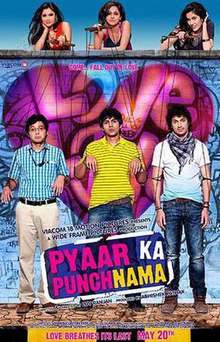



Discription
PYAAR KA PUNCHNAMA (2011)
Summary:
Pyaar Ka Punchnama is a satirical romantic comedy-drama that delves into the lives of three bachelors – Rajat, Nishant, and Vikrant – whose carefree existence takes a drastic turn when they each fall in love. The film chronicles their tumultuous relationships, highlighting the challenges, frustrations, and often comedic pitfalls of modern romance from a male perspective. As their initial romantic highs give way to the harsh realities of their girlfriends' demands, manipulations, and emotional complexities, the friends find their lives increasingly dominated and complicated by their relationships, leading to a series of escalating conflicts and ultimately, a collective breaking point.
The movie gained significant popularity for its raw, relatable, and often controversial portrayal of relationship dynamics, particularly through its famous monologues that articulate the male perspective on the "problems" in modern dating. It explores themes of compromise, sacrifice, communication breakdowns, and the struggle to maintain individuality within a partnership, all wrapped in a humorous yet poignant narrative that resonated deeply with a young audience, ultimately becoming a cult classic that spawned a successful sequel.
Keywords: Pyaar Ka Punchnama, 2011, Kartik Aaryan, Divyendu Sharma, Raayo S. Bakhirta, Nushrratt Bharuccha, Sonalli Sehgall, Ishita Raj Sharma, Romantic Comedy, Drama.
Plot:
The film opens by introducing three close friends and flatmates in Delhi: Rajat (Rajat), a somewhat naive and easily influenced young man; Nishant (Liquid), an earnest and slightly awkward software engineer; and Vikrant (Chauka), the more pragmatic and seemingly grounded of the trio. They share a comfortable bachelor pad and a strong bond, often commiserating about life, work, and their general disinterest in serious relationships, preferring their carefree independence. Their lives take an unexpected turn when love, or what they perceive as love, enters their lives. Rajat meets Neha, a seemingly charming and sophisticated girl, at a party. Nishant, through a series of coincidences, encounters Charu, a beautiful but seemingly fragile girl who works as a sales executive. Vikrant, meanwhile, starts dating Rhea, a high-maintenance and socially active woman who is part of his social circle. The initial phases of these relationships are depicted as idyllic, filled with romantic gestures, passionate encounters, and the intoxicating feeling of being in love. The friends' lives begin to revolve around their respective girlfriends, leading to a gradual shift in their priorities, their routines, and their camaraderie, as their individual worlds increasingly merge with those of their partners.
However, the honeymoon period soon gives way to the harsh realities and complexities of modern relationships, as the distinct personalities and expectations of the women begin to surface, creating friction and frustration for the men. Rajat's relationship with Neha quickly devolves into a series of financial and emotional drains. Neha proves to be incredibly demanding, possessive, and manipulative. She constantly expects Rajat to pay for everything, from expensive dinners to lavish shopping sprees, draining his savings and pushing him into debt. Her emotional blackmail is relentless; she frequently picks fights over trivial matters, accusing Rajat of not caring enough, and uses tears to get her way. Rajat finds himself constantly apologizing, trying to pacify her, and sacrificing his own desires and friendships to meet her unending demands. A pivotal scene involves Neha's irrational anger over Rajat's choice of pizza toppings, escalating into a full-blown emotional breakdown, leaving Rajat bewildered and exhausted. He also struggles with her constant need for attention and her subtle attempts to isolate him from his friends, particularly from Nishant and Vikrant, whom she views as bad influences.
Nishant's relationship with Charu is characterized by her cunning manipulation and his own naive desperation to please her. Charu, while appearing sweet and vulnerable, strategically uses Nishant for her personal gain. She convinces him to find her a new apartment, then manipulates him into paying a significant portion of her rent, despite him being a struggling software engineer. She uses his connections to secure a job for herself, only to constantly complain about it and show little gratitude. Charu frequently brings up her ex-boyfriend, comparing Nishant to him and subtly undermining his confidence. She's emotionally distant, never fully committing to Nishant, and keeps him on a leash, making him feel like he constantly needs to prove his worth. Nishant, blinded by his affection and belief in her vulnerability, keeps making excuses for her behavior, pouring his energy and finances into a relationship where he receives little emotional return. His friends repeatedly warn him, but he remains steadfast in his belief that he can make Charu happy and that she will eventually reciprocate his feelings genuinely.
Vikrant's relationship with Rhea, while seemingly more stable initially, eventually reveals its own set of challenges rooted in incompatibility and differing expectations. Rhea is a socialite who values appearances, social status, and a high-maintenance lifestyle. She expects Vikrant to constantly entertain her, take her to exclusive parties, and spend lavishly, often prioritizing her friends and social engagements over their private time. Vikrant, who initially tries to keep up with her demands, soon finds himself financially strained and emotionally exhausted. He struggles with her superficiality and her inability to understand his simpler needs for genuine connection. A significant conflict arises when Rhea plans a surprise birthday party for Vikrant without consulting him, inviting all her friends and acquaintances, turning it into a social event rather than an intimate celebration. Vikrant feels overlooked and unappreciated, his attempts to communicate his feelings often met with Rhea's defensive reactions or dismissals, making him feel like an accessory rather than a partner. The three friends frequently gather, sharing their relationship woes, offering each other often-unhelpful advice, and finding solace in their shared misery, highlighting their dwindling individual lives outside their relationships.
The climax of the film sees each relationship reaching its breaking point. Rajat, pushed to his absolute limit by Neha's incessant demands, emotional manipulation, and financial exploitation, delivers his iconic "problem kya hai?" monologue. In a powerful and cathartic outburst, he articulates the myriad frustrations, illogical expectations, and emotional burdens placed on men in modern relationships, questioning why women complicate things so much and why men are always expected to understand and compromise. Nishant finally witnesses Charu with another man, a richer, more established individual, confirming his friends' warnings and exposing Charu's true opportunistic nature. Devastated but finally enlightened, Nishant confronts Charu, ending their manipulative charade. Vikrant, after a particularly draining series of events and realizing Rhea's fundamental lack of understanding and commitment, decides to end their relationship, choosing his peace of mind over a superficial partnership. The film concludes with the three friends reuniting in their bachelor pad, single once more. They find a renewed sense of freedom and camaraderie, albeit with a newfound cynicism about love and relationships. They have come full circle, but with the painful wisdom gained from their experiences, choosing their brotherhood and independence over the complicated entanglement of romance, returning to their original carefree, yet now wiser, existence.
Cast (Lead Roles):
- Kartik Aaryan as Rajat (Rajjo)
- Divyendu Sharma as Nishant Agarwal (Liquid)
- Raayo S. Bakhirta as Vikrant Chaudhary (Chauka)
- Nushrratt Bharuccha as Neha
- Sonalli Sehgall as Rhea
- Ishita Raj Sharma as Charu
Crew:
- Director: Luv Ranjan
- Producers: Abhishek Pathak, Kumar Mangat Pathak
- Writers: Luv Ranjan, Rahul Mody
- Music Director: Hitesh Sonik, Clinton Cerejo
- Cinematography: Sudhir K. Chaudhary
- Editor: Akiv Ali
Release Info:
- Original Release Date: May 20, 2011
- Language: Hindi
- Genre: Romantic Comedy, Drama
- Running Time: 140 minutes
- Accolades: Gained cult status for its relatable portrayal of modern relationships; spawned a successful sequel, Pyaar Ka Punchnama 2.