


Discription
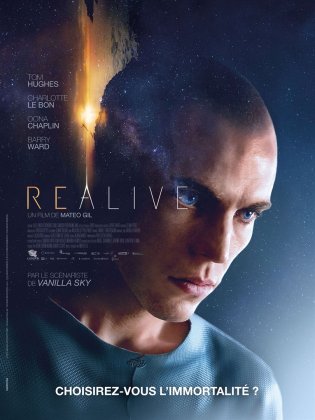
REALIVE (PROJECT LAZARUS) (2016)
Summary:
Marc Jarvis, a successful advertising executive, receives a devastating diagnosis of a terminal brain tumor. Faced with an imminent death sentence, he makes the radical decision to undergo cryopreservation, opting to freeze his body in the hope that future medical advancements will offer a cure. He says a heartbreaking goodbye to his beloved girlfriend, Naomi, who chooses to live out her natural life.
Sixty years later, Marc is successfully resurrected by the advanced medical corporation Pronlonga, becoming the first human to be brought back from cryosleep. He awakens in a technologically dazzling but emotionally sterile 2084, a world vastly different from the one he left behind. As he undergoes intensive physical and psychological rehabilitation, Marc grapples with the profound loss of his past, the absence of Naomi, and an overwhelming sense of alienation in a future he never imagined. The film delves into his struggle to forge a new identity, confront the ethical implications of his existence, and understand what it truly means to live when one has bypassed death.
Keywords: Realive, Project Lazarus, 2016, Tom Hughes, Charlotte Le Bon, Oona Chaplin, Barry Ward, Sci-Fi, Drama, Romance, Cryopreservation, Immortality, Identity, Grief, Future.
Plot:
The film opens by introducing Marc Jarvis, a charismatic and successful advertising executive, living a vibrant life in the present day with his girlfriend, Naomi. Their relationship is depicted as deeply loving and passionate, filled with shared dreams and intimate moments that establish the profound connection they share. This idyllic existence is shattered by a devastating diagnosis: Marc has an inoperable brain tumor, giving him only a year to live. Faced with the certainty of premature death, Marc initially struggles with despair, but soon learns about an experimental procedure offered by a company called Pronlonga: cryopreservation. This radical option allows him to freeze his body, gambling on the hope that future medical science will find a cure for his condition, effectively postponing his death by decades, or even centuries.
The decision to undergo cryopreservation is not an easy one, particularly for Naomi. While she supports Marc's choice to fight for his life, she cannot bring herself to join him in cryosleep. She chooses to live out her natural life, a decision that creates an agonizing emotional chasm between them. The film poignantly portrays Marc's final days, filled with emotional goodbyes to his family and, most intensely, to Naomi. Their last moments together are a heartbreaking blend of love, sorrow, and the impossible promise of a reunion that may never come. The actual cryopreservation process is depicted clinically, with Marc's consciousness fading as his body is meticulously prepared and frozen, marking the end of his known existence and the beginning of an uncertain future.
Sixty years later, in the year 2084, Marc awakens. He is the first successful subject of human reanimation, brought back to life by Dr. Grinberg and her dedicated team at Pronlonga. The initial moments of his awakening are disorienting; he is in a sterile, futuristic medical facility, surrounded by unfamiliar faces and advanced technology. The world outside has changed beyond recognition, a fact that slowly dawns on him as he undergoes a rigorous process of physical and mental rehabilitation. His body, having been dormant for decades, needs to be re-acclimated to life, while his mind must contend with the immense temporal leap and the overwhelming sense of loss and displacement. He is essentially a newborn in an alien world, constantly monitored and analyzed.
As Marc slowly recovers, he is introduced to the marvels and stark realities of 2084. The world is a technological utopia, with holographic interfaces, advanced transportation, and seemingly limitless resources. However, it also feels emotionally distant and sterile, a stark contrast to the vibrant, tactile world he remembers. His primary caregiver and psychologist, Eva, guides him through this new existence, helping him understand the societal shifts, cultural changes, and scientific advancements that have occurred. Despite the wonders, Marc feels profoundly isolated. He is an anomaly, a living ghost from the past, constantly grappling with the paradox of his resurrection: he has gained life, but lost everything that made it meaningful.
The central emotional anchor for Marc remains Naomi. His memories of her are vivid and frequent, often manifesting as dreamlike flashbacks that intercut with his present reality. These memories are not just nostalgic; they are a source of profound grief and longing. He desperately seeks information about her, clinging to the hope that she might have been preserved or that some trace of her still exists. The discovery, facilitated by Eva and Dr. Grinberg, is devastating: Naomi lived a full life after his cryopreservation, eventually marrying another man, having children, and dying naturally decades ago. This revelation shatters Marc, forcing him to confront the agonizing truth that while he was frozen in time, the love of his life moved on, creating a new existence without him. He realizes the full, crushing weight of his decision and the ultimate sacrifice Naomi made by letting him go.
Marc's struggle deepens into an existential crisis. He questions his identity: is he still Marc Jarvis, or merely a revived specimen, an experimental subject? He feels like an artifact, a curiosity to the scientific community, rather than a person with agency and purpose. Dr. Grinberg, while clinically detached, also exhibits a degree of fascination and perhaps even a protective instinct towards her unique patient. Eva, however, develops a more personal connection with Marc, offering him empathy and trying to help him navigate his complex emotions. She becomes a bridge between his past and the new world, though she can never truly fill the void left by Naomi. Marc grapples with the ethical implications of his existence, feeling the burden of being the first, and the responsibility that comes with such a monumental scientific achievement.
The film masterfully uses recurring flashbacks and dream sequences to illustrate Marc's internal turmoil. These aren't just simple memories; they are vivid, immersive experiences that transport the viewer back to his life with Naomi, highlighting their deep bond, their laughter, their arguments, and their shared future that was cruelly cut short. These sequences serve to intensify Marc's grief, constantly reminding him of what he lost and creating a stark, poignant contrast with his sterile, solitary present. They are a constant torment, preventing him from fully embracing the new world, yet also the only tangible link he has to his former self and the love that defined him. The beauty of these memories clashes violently with the cold, hard reality of his resurrected life, emphasizing his profound loneliness.
Driven by a desperate need to find meaning, Marc tries to engage with the new world. He explores futuristic art, listens to music, and attempts to understand the cultural shifts. He even tries to reconnect with aspects of his old life, but finds that everything has changed beyond recognition. His old apartment building is gone, replaced by towering structures; his friends and family are long dead. He is a man without a country, without a past, trying to build a future on shifting sands. He tries to learn new skills, to find a place for himself, but the shadow of Naomi and his lost life constantly looms, making it difficult to fully commit to anything new. He feels like an observer, perpetually alienated from the society he now inhabits.
The film culminates in Marc's gradual, albeit painful, acceptance of his new reality. He realizes that while he can never truly reclaim his past, he must find a way to integrate it with his present. He understands that true life, even in this immortal state, requires connection and purpose. While the ending is not overtly triumphant, it offers a bittersweet resolution. Marc begins to create a new life for himself, perhaps through art or a quiet pursuit that allows him to express his unique journey. He learns to carry the weight of his memories without being crushed by them, accepting that Naomi will always be a part of him, but that he must also forge a new path. The film leaves the audience with profound philosophical questions about life, death, love, and what it truly means to be human in an age where mortality itself can be challenged, suggesting that even with infinite time, the human heart still yearns for finite, meaningful connections.
Cast (Lead Roles):
- Tom Hughes as Marc Jarvis
- Charlotte Le Bon as Naomi
- Oona Chaplin as Eva
- Barry Ward as Dr. Grinberg
Crew:
- Director: Mateo Gil
- Writer: Mateo Gil
- Producers: Ibon Cormenzana, Ignasi Estapé, Sandra Tapia
- Cinematography: Pau Esteve Birba
- Editor: Jacobo Martín
- Music: Lucas Vidal
Release Info:
- Original Release Date: September 23, 2016 (Spain)
- Language: English, Spanish
- Genre: Sci-Fi, Drama, Romance
- Running Time: 112 minutes
- Accolades: Nominated for 3 Goya Awards (Best Original Score, Best Production Design, Best Special Effects)