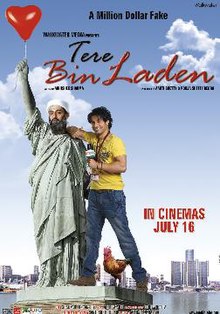


Discription
TERE BIN LADEN (2010)
Summary:
Tere Bin Laden is a satirical comedy that follows Ali Hassan, a young, ambitious but perpetually unlucky television reporter in Karachi, Pakistan, who dreams of emigrating to the United States. Frustrated by repeated visa rejections and a dead-end career, Ali concocts an audacious plan: to create a fake video of Osama bin Laden to gain international attention and secure his coveted US visa. He enlists his loyal cameraman, Gul, and together they discover Noora, an elderly chicken farmer who bears an uncanny resemblance to the infamous terrorist, particularly with a carefully styled beard.
The film brilliantly chronicles the hilarious and increasingly chaotic consequences of their elaborate hoax. What starts as a desperate attempt to manipulate the media quickly spirals out of control as the fabricated videos go viral, attracting the attention of both bumbling American intelligence agents and real, dangerous terrorist organizations. Ali finds himself caught in a web of his own making, balancing his personal aspirations with the genuine peril posed by those who believe his fake videos are real, all while satirizing media sensationalism, global paranoia, and cultural misunderstandings.
Keywords: Tere Bin Laden, 2010, Ali Zafar, Pradhuman Singh, Satirical Comedy, Black Comedy, Hoax, Pakistan, Osama bin Laden.
Plot:
The story opens in Karachi, Pakistan, introducing Ali Hassan, a tenacious but perpetually struggling television reporter for a local news channel. Ali's primary ambition in life is to move to the United States, a dream constantly thwarted by repeated visa rejections. His boss, Majeed Khan, is a demanding and often dismissive figure who pushes Ali to deliver sensational stories, but Ali's attempts typically fall flat. Frustrated and desperate, Ali becomes convinced that only a truly groundbreaking, internationally significant scoop can pave his way to America.
Inspired by the global obsession with Osama bin Laden and the constant stream of his video messages, Ali hatches an audacious and ethically dubious plan: he will fake a new Osama bin Laden video. He believes that by creating a viral sensation, he can manipulate the US government into granting him a visa, perhaps even as a "source" or someone with unique access. He confides in his loyal and somewhat naive cameraman, Gul, who, despite initial reservations, agrees to help Ali execute this elaborate hoax. Their first challenge is finding an actor convincing enough to play the world's most wanted man.
Their search leads them to Noora, an elderly, simple-minded chicken farmer from a remote village who, with a little makeup and a strategically grown beard, bears an astonishing resemblance to Osama bin Laden. Noora, initially bewildered by Ali's proposition, is persuaded by the promise of money to help his family. He has no real understanding of who Osama bin Laden is or the gravity of the situation, often getting confused and asking mundane questions about chickens or his daily routine during filming. This stark contrast between Noora's innocence and the dangerous implications of the videos forms much of the film's comedic backbone. Ali, Gul, and Noora set up a makeshift studio in a dilapidated shack, using cheap props and Ali's rudimentary scriptwriting skills to create their first "exclusive" video. Noora's performance is often clumsy, requiring multiple takes and Ali's constant, exasperated direction.
The first video is a bizarre concoction: Noora, in character, delivers a rambling speech about the price of eggs and the importance of chickens, interspersed with generic anti-Western rhetoric that Ali has cobbled together. Ali anonymously uploads the video to the internet. To his astonishment, and terror, the video becomes an overnight global sensation. International news channels dissect every frame, intelligence agencies scramble to analyze its cryptic messages, and even genuine terrorist organizations interpret it as a coded signal. The US government takes the video extremely seriously, launching a full-scale investigation. Ali's initial elation quickly turns to panic as he realizes the magnitude of the monster he has created. His boss, Majeed, unknowingly fuels the fire by praising Ali for his "exclusive" access and demanding more such content, pushing Ali deeper into the hoax.
The success of the first video leads to a second, more overtly threatening one, again delivered by Noora, who still struggles with his lines and often injects his simple observations into the script. This video further escalates the global panic. Suddenly, Ali's long-sought US visa application is fast-tracked, but he is now trapped. He cannot reveal the truth without facing severe consequences, potentially from both the US and the real terrorist groups who are now taking a keen interest in him. The situation becomes even more precarious when a real, dangerous terrorist cell, led by the ruthless Qureshi, begins to track Ali. They believe Ali has genuine contact with Osama bin Laden and sees him as a valuable asset to either recruit or kidnap Noora for their own propaganda purposes, adding a layer of genuine, life-threatening danger to Ali's comedic predicament.
Adding to the chaos are two bumbling American CIA agents, David Chaddha and Ted, who are dispatched to Pakistan to investigate the videos and track down their source. Their incompetence and cultural misunderstandings lead to a series of hilarious misinterpretations and botched operations, often just missing Ali and Noora. They are convinced Ali is either a direct contact of bin Laden or a key player in a new terror network. As the pressure mounts from all sides, Ali realizes he needs to get Noora out of the picture, perhaps even out of the country, to protect both Noora and himself from the escalating danger and to maintain his increasingly fragile lie.
The climax unfolds in a highly chaotic and farcical sequence at the airport. Ali, with his newly approved US visa in hand, plans to escape Pakistan, but first, he must ensure Noora's safety and silence. He attempts to smuggle Noora, still disguised as Osama, out of the city. However, the airport becomes a convergence point for all the interested parties: Ali, attempting to leave; the CIA agents, hot on Ali's trail; and Qureshi's terrorist group, determined to kidnap Noora. A series of mistaken identities, near-misses, and frantic chases ensue. Noora, confused and disoriented, gets separated from Ali, leading to further pandemonium. In the midst of this, a major twist occurs: the real Osama bin Laden's group releases an actual video, which, by sheer coincidence and Ali's uncanny ability to tap into the "market" for such messages, is eerily similar in tone and content to Ali's fake creations. This further blurs the line between reality and deception, creating unprecedented confusion for everyone involved.
In the resolution, Noora is eventually apprehended by the US agents amidst the airport chaos. However, his simple answers and inability to coherently explain anything lead the agents to conclude he is either a decoy, a mentally unstable individual, or simply not the real Osama bin Laden. They decide to deport him back to his village, none the wiser about his global impact. Ali, through a combination of sheer luck, the CIA's incompetence, and the general confusion, manages to evade capture and board his flight to the US. The film ends with Ali finally arriving in America, achieving his lifelong dream, but the irony is palpable. His success is built entirely on a monumental lie that caused international panic and confusion. He sees news reports about the ongoing search for Osama bin Laden, a subtle acknowledgment that the cycle of fear, media sensationalism, and misdirection continues. Noora, back in his village, resumes his simple life, perhaps a little richer but oblivious to the global storm he unwittingly created, leaving the audience to ponder the absurdity of modern media and intelligence in a post-9/11 world.
Cast (Lead Roles):
- Ali Zafar as Ali Hassan
- Pradhuman Singh as Noora / Osama Bin Laden
- Piyush Mishra as Majeed Khan
- Nikhil Ratnaparkhi as Gul
- Sugandha Garg as Zoya Khan
- Barry John as David Chaddha
- Chinmay Mandlekar as Qureshi
- Rahul Singh as Ted
Crew:
- Director: Abhishek Sharma
- Writer: Abhishek Sharma
- Producers: Pooja Shetty Deora, Aarti Shetty
- Music Director: Shankar-Ehsaan-Loy
- Cinematography: Anshuman Mahaley
- Editor: Chandan Arora
Release Info:
- Original Release Date: July 16, 2010
- Language: Hindi, Urdu, English
- Genre: Satirical Comedy, Black Comedy
- Running Time: 95 minutes
- Accolades: Critically acclaimed for its unique premise and humor. Nominated for several awards, including Filmfare Awards for Best Debut Actor (Ali Zafar) and Best Screenplay. Won Stardust Award for Best Debut Director (Abhishek Sharma).