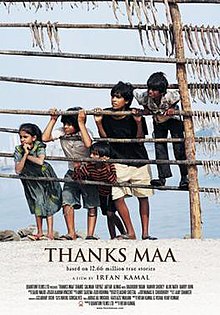


Discription
THANKS MAA (2010)
Summary:
Thanks Maa is a poignant Indian drama film that chronicles the extraordinary journey of a street urchin named Emptiness (Golgappa in some versions) in Mumbai. When he discovers an abandoned newborn baby girl in a trash can, his life takes an unforeseen turn. What begins as a reluctant act of kindness quickly evolves into a profound mission as Emptiness, despite his own impoverished circumstances, takes it upon himself to protect and care for the infant, whom he affectionately names Matru (mother).
The film delves deep into the gritty realities of Mumbai's underbelly, showcasing Emptiness's struggles to provide for Matru, navigate dangerous streets, and evade social workers, all while desperately searching for the baby's biological mother. It's a powerful narrative about innocence, responsibility, and the unexpected bonds that form in the most challenging environments, ultimately highlighting the innate human capacity for love and self-sacrifice even when faced with overwhelming odds.
Keywords: Thanks Maa, 2010, Master Salman, Alka Amin, Irfan Kamal, Drama, Social, Family.
Plot:
The film opens by immersing the audience into the chaotic, unforgiving world of Mumbai's streets, seen through the eyes of Emptiness, a sharp-witted yet vulnerable street kid. He's part of a small gang of fellow urchins, including the older, more cynical Jogi, who scrape by through petty theft, begging, and scavenging. Emptiness, despite his name, possesses a keen observational eye and a surprising depth of feeling, often masked by a hardened exterior forged by constant struggle. His daily existence is a relentless fight for survival, where a discarded meal or a few coins are victories, and trust is a luxury he can ill afford.
One sweltering night, while rummaging through a giant communal dustbin in a back alley, Emptiness stumbles upon something that shatters the monotony of his life: a newborn baby, wrapped in a soiled cloth, crying weakly amidst the refuse. His initial reaction is one of shock, followed by an immediate instinct to flee. This is not his problem; he has enough of his own. But the baby's persistent, fragile cries tug at something deep within him. He hesitates, torn between self-preservation and an unfamiliar surge of compassion. Overcoming his fear and the ingrained cynicism of his environment, he carefully picks up the infant, a tiny, helpless bundle that feels alien in his rough hands.
Back at his makeshift shelter under a flyover, Emptiness's friends are bewildered, some amused, some concerned by his new "acquisition." Jogi warns him of the dangers and responsibilities, urging him to abandon the baby. But Emptiness, with a resolve he didn't know he possessed, declares his intention to care for her. He names her "Matru," a word for "mother," a poignant choice for a child who has never known his own. The immediate challenges are monumental: how to feed a newborn when he barely feeds himself? He resorts to begging for milk, stealing a bottle, and even resorting to diluting tea with water to soothe her hunger. Keeping her warm, clean, and safe from the elements and predatory adults becomes his sole focus, transforming his daily grind into a mission.
Emptiness soon makes a solemn vow: he will find Matru's real mother. His quest begins with a naive belief that he can simply ask around. He meticulously retraces his steps to the dustbin, questioning local beggars, ragpickers, and small vendors in the vicinity. He describes the baby, hoping someone might recognize a distraught woman, a recent birth. The responses are mostly indifferent or dismissive, sometimes even hostile. He encounters false leads, rumors, and the cold reality that in a city of millions, one abandoned baby is just another statistic. His initial optimism slowly gives way to frustration, but his determination only hardens with each setback, fueled by Matru's innocent gaze.
As his search widens, Emptiness and Matru venture further into the sprawling, labyrinthine city. Their journey takes them through bustling markets, quiet residential lanes, crowded slums, and dangerous red-light districts. Emptiness learns to adapt, using his street smarts to protect Matru from pickpockets, avoid suspicious characters, and evade the ever-present threat of police or social workers who would undoubtedly separate them. He develops an almost paternal instinct, his eyes constantly scanning for danger, his body instinctively shielding Matru. He learns to change her diapers with scraps of cloth, soothe her cries with lullabies he invents, and finds ingenious ways to keep her fed, even if it means foregoing his own meals.
The emotional and physical toll on Emptiness is immense. He makes countless sacrifices, sharing his meager food, giving up his small "territory" for sleeping, and constantly putting Matru's needs above his own. There are moments of despair when he is overwhelmed by the responsibility, moments when he feels the crushing weight of his impossible task. He longs for the carefree days of simply surviving, but Matru's presence has irrevocably changed him. Her tiny hand gripping his finger, her innocent smile, are enough to rekindle his resolve. He finds unexpected allies in a few kind strangers – a sympathetic chai-wallah who offers warm water, an old woman who gives him a blanket – but mostly, they face the world alone.
Their journey brings them into contact with a dedicated social worker, Mr. Mehta, played by Barry John. Mr. Mehta is initially firm, trying to convince Emptiness to surrender Matru to an orphanage, explaining the dangers of street life for an infant and the legal ramifications of keeping an abandoned child. He sees Emptiness as a child himself, incapable of providing proper care. However, as he witnesses Emptiness's fierce protectiveness, his genuine love for Matru, and the incredible lengths he has gone to, Mr. Mehta begins to see beyond the surface. He presents Emptiness with a moral dilemma: keep Matru in a life of uncertainty and danger, or give her a chance at a better, safer future, even if it means letting her go.
Through sheer persistence and a stroke of luck—perhaps overhearing a crucial snippet of conversation or finding a discarded clue—Emptiness finally gets a solid lead on Matru's mother. The information points him towards a specific slum area, a place even more desolate and desperate than his own. Hope, mixed with a profound sense of dread, fills him. What kind of woman abandons her child? What will he find? The journey to this new location is fraught with tension, a culmination of all his efforts, all his sacrifices leading to this one, potentially life-altering encounter.
Emptiness eventually finds Matru's mother, a young woman named Laxmi, living in abject poverty. The confrontation is raw and heart-wrenching. Laxmi, initially defensive and ashamed, denies everything. But the sight of her baby, healthy and cared for by this street boy, breaks through her defenses. She tearfully confesses her story: abandoned by her partner, ostracized by her family, jobless, and starving, she saw no other option but to leave her baby, hoping someone else might give her a life she couldn't. It's a moment of profound sadness, revealing the desperate circumstances that can drive a mother to such an unthinkable act.
Faced with the reality of Matru's mother, Emptiness is confronted with the ultimate sacrifice. He sees Laxmi's remorse, her genuine love for her child despite her past actions. He understands, with a maturity far beyond his years, that while he loves Matru, he cannot provide her with the stable, secure future she deserves. The decision to return Matru to her biological mother, even if that future is still uncertain, is agonizing. It is an act of profound, selfless love, letting go of the one person who had given his "empty" life meaning. He hands Matru over, a single tear tracing a path down his dust-streaked cheek, his heart breaking even as he knows it's the right thing to do.
The film concludes with Emptiness returning to his street life, but he is fundamentally changed. The "emptiness" within him has been filled, not by Matru's physical presence, but by the experience of love, responsibility, and ultimate sacrifice. He is still a street kid, but he carries the indelible mark of his journey. He looks at the world with new eyes, perhaps a little sadder, but infinitely wiser and more compassionate. The final scenes suggest that while his circumstances haven't drastically improved, his spirit has been transformed, hinting at a future where he might find a different kind of purpose, having discovered the immense capacity for love within himself.
Cast (Lead Roles):
- Master Salman as Emptiness (Golgappa)
- Alka Amin as Laxmi (Matru's Mother)
- Barry John as Mr. Mehta (Social Worker)
- Raghuveer Yadav as Jogi
- Baby Ayesha as Matru
- Sanjay Mishra as Beggar
Crew:
- Director: Irfan Kamal
- Producer: Irfan Kamal, Vivek Kumar
- Writer: Irfan Kamal
- Music: Agnee
- Cinematography: Sudhir K. Chaudhary
- Editor: Nipun Gupta
Release Info:
- Original Release Date: 5 March 2010
- Language: Hindi
- Genre: Drama, Social, Family
- Running Time: 110 minutes
- Accolades: National Film Award for Best Child Artist (Master Salman)