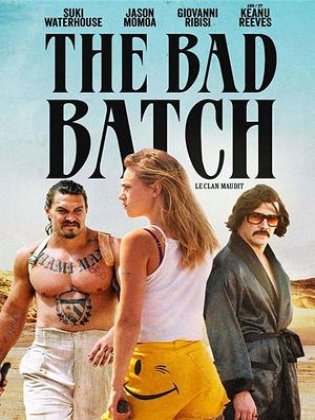



Discription
THE BAD BATCH (2016)
Summary:
Set in a dystopian future, "The Bad Batch" follows Arlen, a young woman exiled from civilized society and cast into a desolate, lawless Texas wasteland populated by outcasts and cannibals. After a brutal encounter with a cannibalistic tribe that leaves her missing an arm and a leg, Arlen must navigate this harsh new reality, seeking survival, belonging, and a semblance of humanity amidst the grotesque and the bizarre.
Her journey leads her through a psychedelic, drug-fueled commune known as Comfort, ruled by the enigmatic "The Dream," and into an unexpected connection with a muscled, artistic cannibal known as Miami Man and his young daughter, Honey. The film is a surreal exploration of identity, freedom, and the search for connection in a world stripped bare of conventional morality, blending elements of horror, romance, and dark comedy.
Keywords: The Bad Batch, 2016, Suki Waterhouse, Jason Momoa, Dystopian, Thriller, Horror, Romance, Ana Lily Amirpour.
Plot:
The film opens with Arlen, a young woman, being unceremoniously marked as "Bad Batch" and expelled from the confines of civilized society. She is driven through a guarded fence and abandoned in the vast, sun-scorched desert of Texas, a lawless wasteland populated by societal rejects and the dangerous. Her initial moments in this new reality are marked by a sense of disorientation and vulnerability, as she navigates the desolate landscape on a skateboard, attempting to assert some control over her dire situation. The environment is immediately established as hostile and unforgiving, a place where the rules of the outside world no longer apply.
Arlen's grim introduction to the wasteland's inhabitants comes swiftly and brutally. She is captured by a primitive, muscle-bound group of cannibals, a tribe that lives by their own gruesome code. In a shocking and visceral sequence, they amputate her right arm and left leg, a horrifying act that underscores the savagery of this new world. Left for dead, Arlen endures a harrowing crawl through the desert, bleeding and dehydrated, a stark testament to her will to survive. She eventually encounters a mute, eccentric old man known as The Hermit, who, without a word, offers her water and points her towards a distant settlement, a beacon of hope amidst the despair.
Following The Hermit's silent guidance, Arlen makes her way to Comfort, a sprawling, makeshift community built from scavenged materials and powered by a vibrant, albeit chaotic, energy. Comfort stands in stark contrast to the barren wasteland and the cannibals' brutal camp. It is a psychedelic, drug-fueled haven, teeming with eccentrics, artists, and hedonists, all seeking refuge and freedom from the world they left behind. The community is presided over by "The Dream," a charismatic, philosophical leader who preaches about unity, purpose, and self-acceptance, even as his followers indulge in a constant state of revelry and altered consciousness. Arlen is fitted with a crude prosthetic leg, a symbol of her adaptation and resilience, and slowly begins to integrate into Comfort's peculiar rhythms.
While scavenging for discarded items outside the perimeter of Comfort on her newly acquired scooter, Arlen has her first glimpse of Miami Man, a heavily tattooed and muscled cannibal, and his young daughter, Honey. Miami Man, despite his fearsome appearance and his tribe's gruesome practices, possesses an unexpected artistic sensibility and a deep paternal devotion. He is searching for Honey's mother, a quest that adds a layer of pathos to his otherwise menacing presence. Arlen observes them from a distance, a silent witness to their strange, intimate dynamic, a stark contrast to the superficial connections she finds in Comfort. This encounter plants a seed of curiosity and a nascent sense of connection within Arlen.
Back in Comfort, Arlen continues her life, but the image of Miami Man and Honey lingers. Later, a tragedy strikes: Honey, having wandered away from her father's compound, is abducted by a different, more savage group of cannibals. Miami Man, devastated by his daughter's disappearance, confronts Arlen, believing she was involved or could offer some insight. He carries a distinctive boombox, a personal item that hints at his past and adds another layer to his complex character. Guilt-ridden and feeling a strange sense of responsibility, Arlen makes a profound decision: she will help Miami Man find Honey. This marks a turning point for Arlen, moving her from passive observer to active participant in the wasteland's brutal drama.
Arlen embarks on a perilous journey back into the unforgiving wasteland, her scooter her only reliable companion. Her quest is fraught with danger, as she navigates treacherous terrain, encounters other desperate scavengers, and battles the relentless elements. Her path eventually leads her to Miami Man's isolated compound, a small, surprisingly personalized sanctuary amidst the desolation, where he lives with his other daughter. This discovery reveals a more intimate side of Miami Man, a man who, despite his cannibalistic lifestyle, yearns for a semblance of family and stability.
Upon finding Honey, Arlen takes on a protective role, bringing the traumatized child back to Miami Man's compound. She begins to care for Honey, feeding her and offering comfort, slowly building an unexpected and tender bond. Honey, initially withdrawn and fearful, gradually opens up to Arlen, finding solace in her presence. Arlen, in turn, sees a reflection of her own vulnerability and deep-seated longing for connection in Honey, a mirror to her own experiences of loss and displacement. This developing relationship highlights Arlen's capacity for empathy and nurturing, qualities that seemed lost in her brutalized existence.
The film culminates in a tense yet profoundly human confrontation when Miami Man returns to his compound, finding Arlen and Honey together. His initial wariness gives way to a complex understanding as he witnesses Arlen's genuine care for his daughter. What begins as a standoff evolves into a nuanced negotiation, a silent acknowledgment of shared humanity and a mutual desire for Honey's well-being. Miami Man, in a rare moment of vulnerability, reveals fragments of his past, his artistic inclinations, and his desperate desire for a stable, loving environment for Honey. Arlen, having experienced both the extreme brutality of the cannibals and the superficial hedonism of Comfort, finds herself at a crucial crossroads, forced to make a choice that will define her future.
In a powerful and understated resolution, Arlen makes a profound choice: she decides to stay with Miami Man and Honey, accepting a place within their unconventional, makeshift family unit. This decision transcends mere survival; it represents Arlen finding a form of belonging and purpose that neither civilized society nor the chaotic freedom of Comfort could offer. The film concludes with Arlen, Miami Man, and Honey together, a fragile yet authentic family unit existing in the heart of the desolate wasteland. The ending is ambiguous but carries a strong sense of new beginnings, suggesting that even in the most extreme and lawless circumstances, humanity can forge deep connections and redefine what it means to be a family. "The Bad Batch" ultimately explores themes of identity, freedom, belonging, and the search for meaning in a world where societal norms have utterly collapsed, leaving behind a stark yet strangely beautiful landscape of human resilience and unexpected connection.
Cast (Lead Roles):
- Suki Waterhouse as Arlen
- Jason Momoa as Miami Man
- Jim Carrey as The Hermit
- Keanu Reeves as The Dream
- Giovanni Ribisi as Bobby
- Jayda Fink as Honey
Crew:
- Director: Ana Lily Amirpour
- Writer: Ana Lily Amirpour
- Producers: Danny Gabai, Sina Sayyah, Megan Ellison, Eddy Moretti
- Cinematography: Lyle Vincent
- Editor: Alex O'Flinn
- Music: Federico Sanchez, Andy Pavlov
Release Info:
- Original Release Date: September 6, 2016 (Venice Film Festival)
- Language: English
- Genre: Dystopian, Thriller, Romance, Horror
- Running Time: 118 minutes
- Accolades: Special Jury Prize (Venice Film Festival)