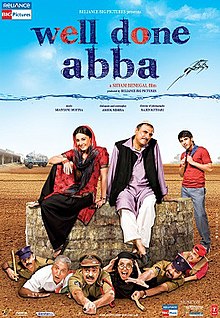


Discription
WELL DONE ABBA (2010)
Summary:
Well Done Abba is a satirical comedy-drama film directed by Shyam Benegal, renowned for his realistic and socially conscious cinema. The movie intricately weaves a tale around the bureaucratic absurdities faced by a common man in rural India, seen through the eyes of his discerning daughter. The narrative centers on Armaan Ali, a humble driver, who embarks on an unconventional quest to avail a government scheme for digging a well on his small plot of land. His prolonged "disappearance" during this mission prompts his Mumbai-based daughter, Muskaan, to return to her village and unravel the mystery.
The film brilliantly exposes the labyrinthine pathways of Indian bureaucracy, the pervasive corruption, and the resilience of an ordinary citizen determined to navigate it. It's a poignant yet humorous commentary on the socio-political landscape, highlighting the stark contrast between urban aspirations and rural realities, while also celebrating the spirit of perseverance against systemic inefficiencies. The movie garnered critical acclaim for its sharp wit, compelling performances, and its insightful portrayal of contemporary India's challenges.
Keywords: Well Done Abba, 2010, Boman Irani, Minissha Lamba, Shyam Benegal, Satire, Bureaucracy, Rural India, Comedy, Drama, Social Issues.
Plot:
The story of Well Done Abba unfolds with Muskaan Ali (Minissha Lamba), a bright and modern young woman, living and working in Mumbai. She is deeply concerned because her father, Armaan Ali (Boman Irani), a simple and honest driver for a wealthy Parsi family (the Bhatnagars), has been missing for three months. Her urgent calls to her village, Chikhalgaon in rural Maharashtra, yield no concrete answers, prompting her to take leave from her job and rush back home to find him. Her fiancé, Arif (Sameer Dattani), and his family are supportive but equally puzzled by Armaan's sudden disappearance, especially since Muskaan's wedding preparations are underway.
Upon her arrival in Chikhalgaon, Muskaan finds the local police unhelpful and her relatives equally clueless. She begins her own investigation, talking to villagers, friends, and acquaintances of her father. As she pieces together fragments of information, the narrative seamlessly transitions into flashbacks, revealing Armaan's life leading up to his disappearance. Armaan is portrayed as a meticulous man, dedicated to his job and his daughter's well-being. The catalyst for his extraordinary journey is a seemingly minor incident: while driving Mrs. Bhatnagar, his car hits a pothole, causing a jolt. During their conversation, Mrs. Bhatnagar mentions government schemes for farmers, specifically one that offers compensation for digging wells to improve irrigation. Armaan, who owns a small, dry plot of land in his village, sees this as an opportunity to secure his daughter's future and improve his family's livelihood.
With newfound determination, Armaan decides to apply for the well scheme. This decision marks the beginning of his immersion into the bewildering world of Indian bureaucracy. His first stop is the local sarpanch (village head), a man more interested in political maneuvering and personal gain than in serving his constituents. Armaan is met with apathy, demands for various forms, and the subtle expectation of "chai-paani" (bribes) at every step. He is sent from the Talathi (village accountant) to the Block Development Officer (BDO), then to the Collector's office, and back again, each official demanding more documents, more signatures, and more patience. He encounters a series of quirky and corrupt government employees, each with their own unique way of delaying or complicating the process.
Armaan, initially naive, gradually learns the unwritten rules of the game. He meticulously keeps a diary, documenting every meeting, every form submitted, every bribe paid (often small amounts, but adding up), and every promise made. He learns to wait for hours, sometimes days, outside offices, to chase down elusive clerks, and to understand the subtle cues of officialdom. His journey is a testament to his quiet perseverance, a stark contrast to Muskaan's growing frustration and sense of helplessness in the present as she tries to locate him. Muskaan's search often leads her to the same government offices her father visited, giving her a glimpse into the very system that has swallowed him.
The film cleverly interweaves the personal quest of Armaan with the larger political landscape of the village. Local elections are looming, and the incumbent sarpanch and the aspiring MLA (Member of Legislative Assembly) are engaged in their own power struggles. Armaan's well application, at times, becomes a minor pawn in their political chess game, sometimes used as a token of progress, other times conveniently forgotten. The satirical elements come to the forefront as the film showcases the absurdity of a system where a simple application can take months, even years, to process, and where honesty is often punished while corruption is implicitly rewarded.
The turning point in Muskaan's search comes when she discovers her father's detailed diary. This diary is not just a record of his bureaucratic battles but also a window into his mind – his hopes, his frustrations, and his growing understanding of the system. Through the diary, Muskaan realizes that her father is not truly "missing" but has intentionally made himself unavailable for his driving job and other family obligations to dedicate all his time and energy to his mission. He is living frugally, staying with various relatives and friends in different towns, following up on his applications, believing that constant presence is the only way to make progress.
Armaan's strategy is both ingenious and heartbreaking. He understands that if he were easily reachable, he would be called back to work, his pursuit of the well would be secondary. By making himself "unavailable," he forces himself and the system to confront his singular objective. The film highlights the irony: a man disappears to fulfill a government scheme meant to help him, only to be found by his daughter who unravels his "disappearance" through the very bureaucratic paper trail he created.
The climax of the film sees Armaan finally receive the sanction for his well, but not without a final, characteristic twist of bureaucratic delay and political maneuvering. The well is eventually dug, symbolizing a hard-won victory for the common man. Muskaan, initially bewildered and angry, comes to understand and deeply admire her father's tenacious spirit and his unique, almost Gandhian, way of fighting for what he believes in. The film concludes on a bittersweet note, celebrating Armaan's individual triumph against overwhelming odds, while simultaneously serving as a sharp critique of a system that forces its citizens to go to such extraordinary lengths for basic entitlements. The well, finally providing water to his dry land, stands as a monument to his perseverance, a silent commentary on the resilience of the human spirit in the face of systemic inertia.
Cast (Lead Roles):
- Boman Irani as Armaan Ali
- Minissha Lamba as Muskaan Ali
- Sameer Dattani as Arif
- Ravi Kishan as Jaleel
- Divya Dutta as Salma
- Ila Arun as Sarpanch
- Rajit Kapur as Mr. Bhatnagar
- Sonali Kulkarni as Mrs. Bhatnagar
- Sonakshi Sinha as herself (cameo)
Crew:
- Director: Shyam Benegal
- Writer: Ashok Mishra (Dialogue), Shyam Benegal (Story & Screenplay)
- Producer: Reliance Big Pictures
- Music: Shantanu Moitra
- Cinematography: Rajan Kothari
- Editor: Aseem Sinha
Release Info:
- Original Release Date: March 26, 2010
- Language: Hindi
- Genre: Satire, Comedy, Drama, Social
- Running Time: Approximately 140 minutes
- Accolades: National Film Award for Best Film on Social Issues (2010)